Centre Relationships

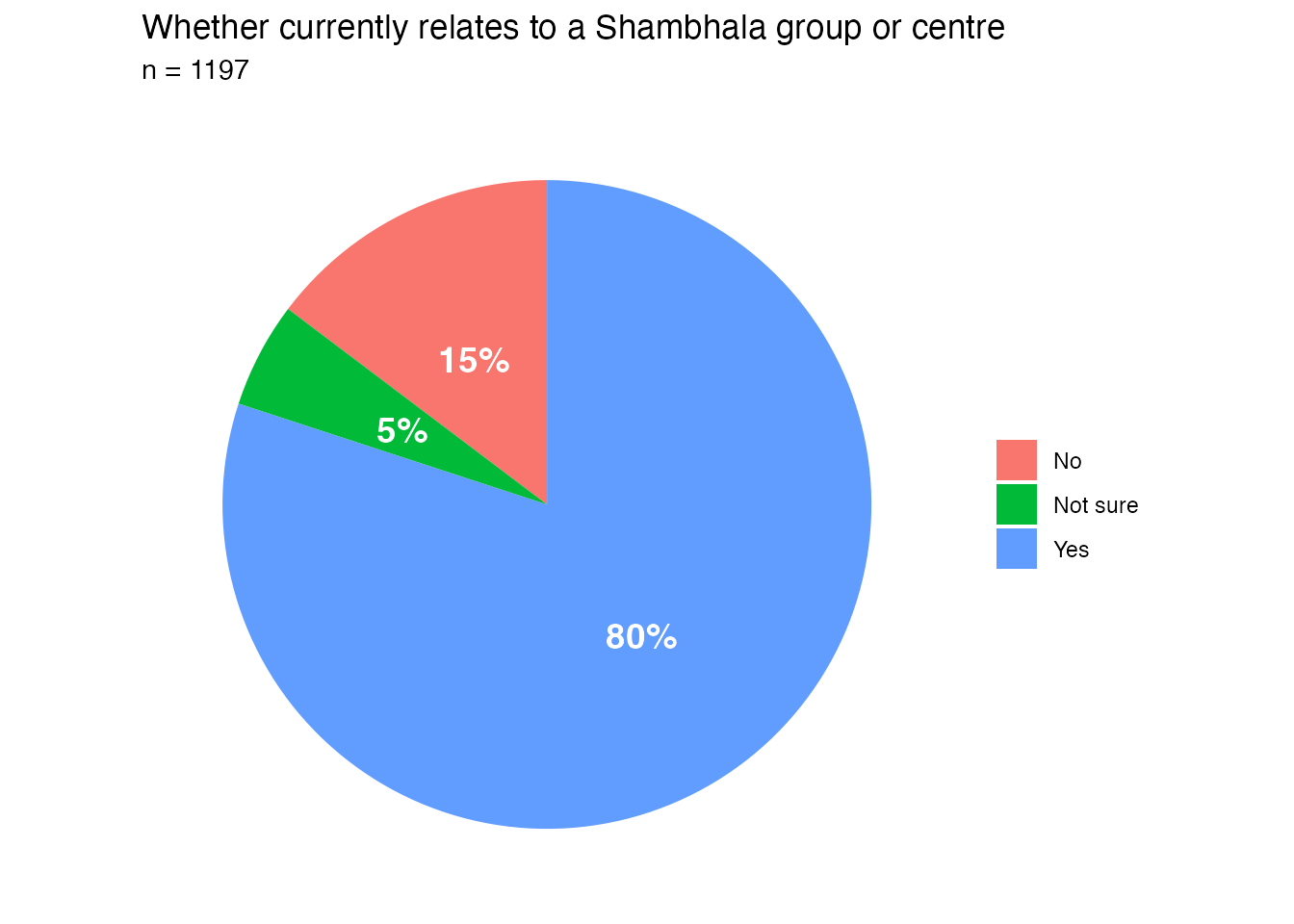
1 Whether currently relates to a Shambhala group/centre

Pie chart showing whether survey respondents currently relate to a Shambhala group or centre. Three slices are labeled Yes, No, and Not sure, each displaying its percentage. Roughly 80 percent of respondents answered Yes, with the remaining 20 percent divided between No and Not sure.
Figure 1

About 80% of survey respondents currently relate to a Shambhala group or centre. The remaining 20% are divided between those who do not and those who are unsure of their connection.

2 Relating to a local centre by centre size
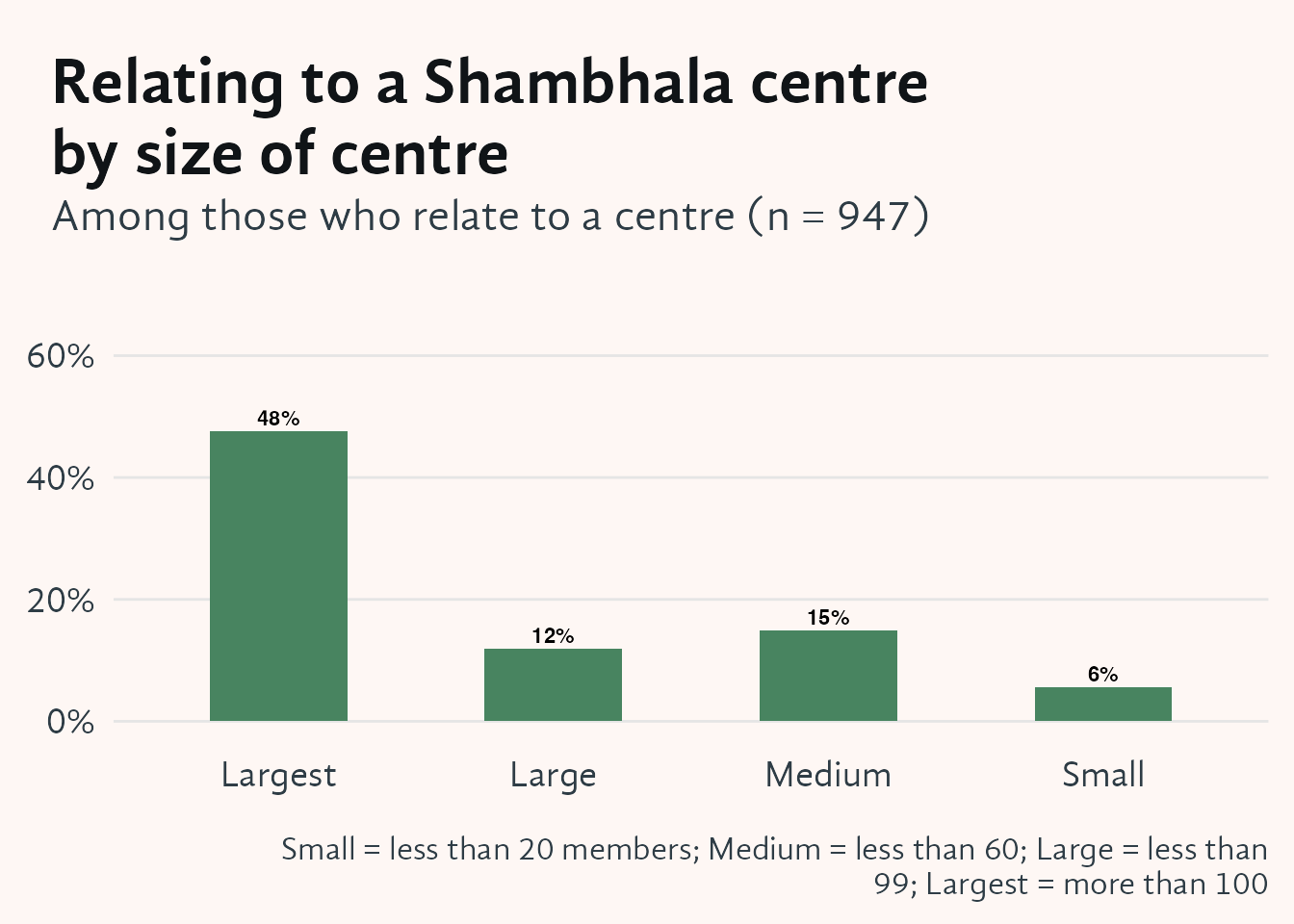
Vertical bar chart showing the percentage of respondents who relate to a Shambhala centre, broken down by centre size on the x-axis (Small, Medium, Large, Largest). The y-axis shows percentage. Around three quarters of respondents relate to centres with more than 60 members, meaning the Large and Largest bars are notably taller than the Small bar.
Figure 2

Among those who relate to a centre, roughly three quarters are affiliated with groups that have more than 60 members. Smaller centres account for a much smaller share of the affiliated respondent population.

Everyone who received a Societal Mirror survey was identified as a member or friend in the Shambhala Database. However, some people who are identified as members in the SDB do not think of themselves as members. In addition, while officially everyone in Shambhala is a global member, and those who are associated with a center are also center members, not everyone feels connected to the global community.

This survey question asks respondents who do relate to a center how they think of themselves in terms of membership. About a quarter of survey respondents who relate to a center consider themselves to be center members only, while more than half consider themselves members of both their local center and global Shambhala.

3 Perceptions of membership of those who relate to a center
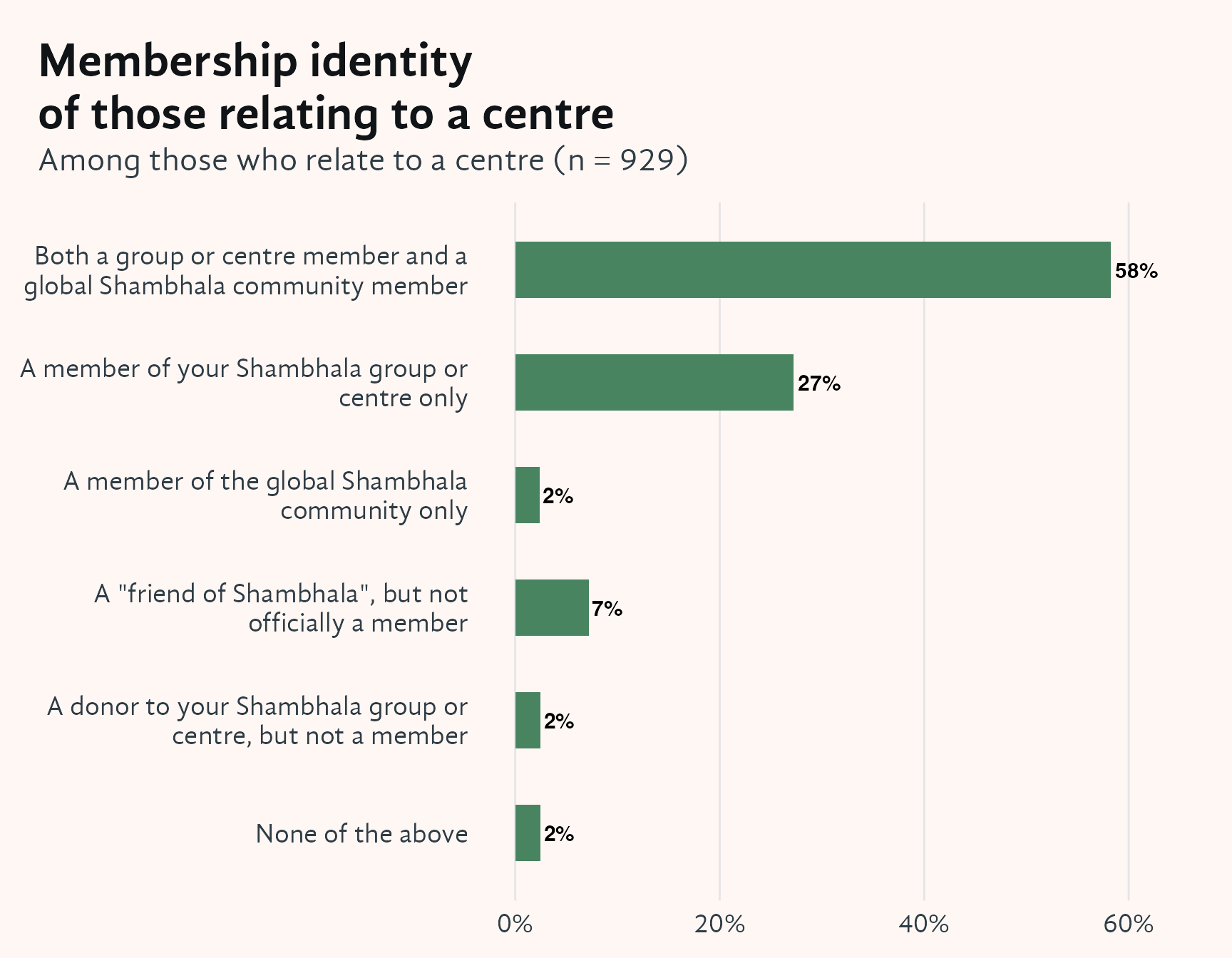
Horizontal bar chart showing how respondents who relate to a Shambhala centre perceive their own membership. Six categories appear on the y-axis, from most to least common: both a centre and global Shambhala community member; centre member only; global community member only; friend of Shambhala but not officially a member; donor but not a member; and none of the above. The x-axis shows percentage. More than half of respondents identify as members of both their local centre and global Shambhala, while about a quarter identify as centre members only.
Figure 3

More than half of those who relate to a centre see themselves as members of both their local centre and the global Shambhala community. About a quarter identify as centre members only, with smaller shares holding other membership identities.

4 Primary membership identity by time period joined
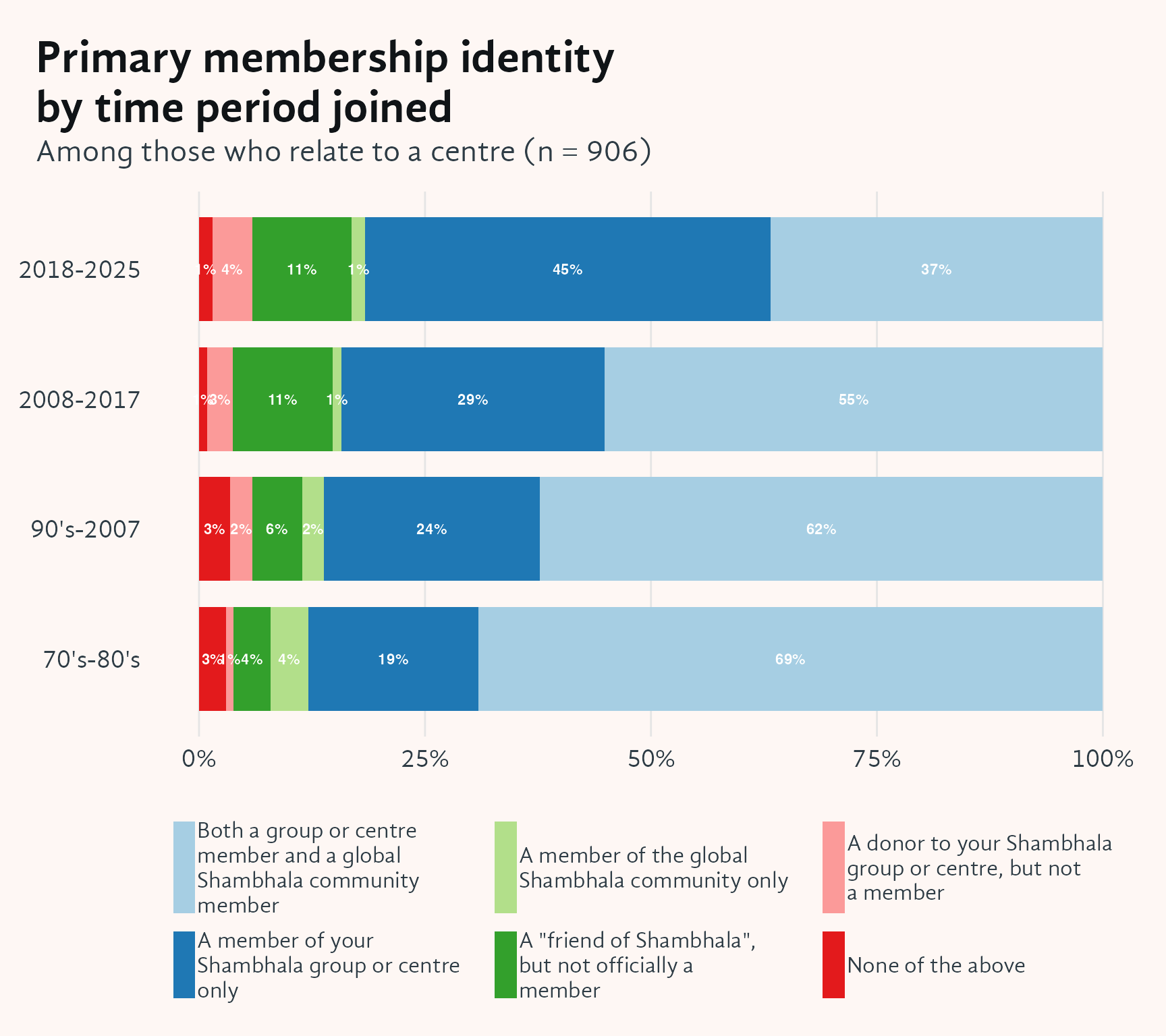
Stacked horizontal bar chart showing primary membership identity broken down by the time period respondents joined Shambhala. Four cohorts appear on the y-axis (70s-80s, 90s-2007, 2008-2017, and 2018 or later); each bar is divided into colored segments representing membership identity categories. Longer-tenured members are more likely to identify as members of both their local centre and the global Shambhala community, while newer entrants are more likely to see themselves as centre members only or as friends rather than formal members.
Figure 4

Longer-tenured members are considerably more likely to see themselves as members of both their local centre and the global Shambhala community. Those who joined more recently more often identify as centre members only, or describe themselves as friends rather than formal members.

5 Primary membership identity by centre size
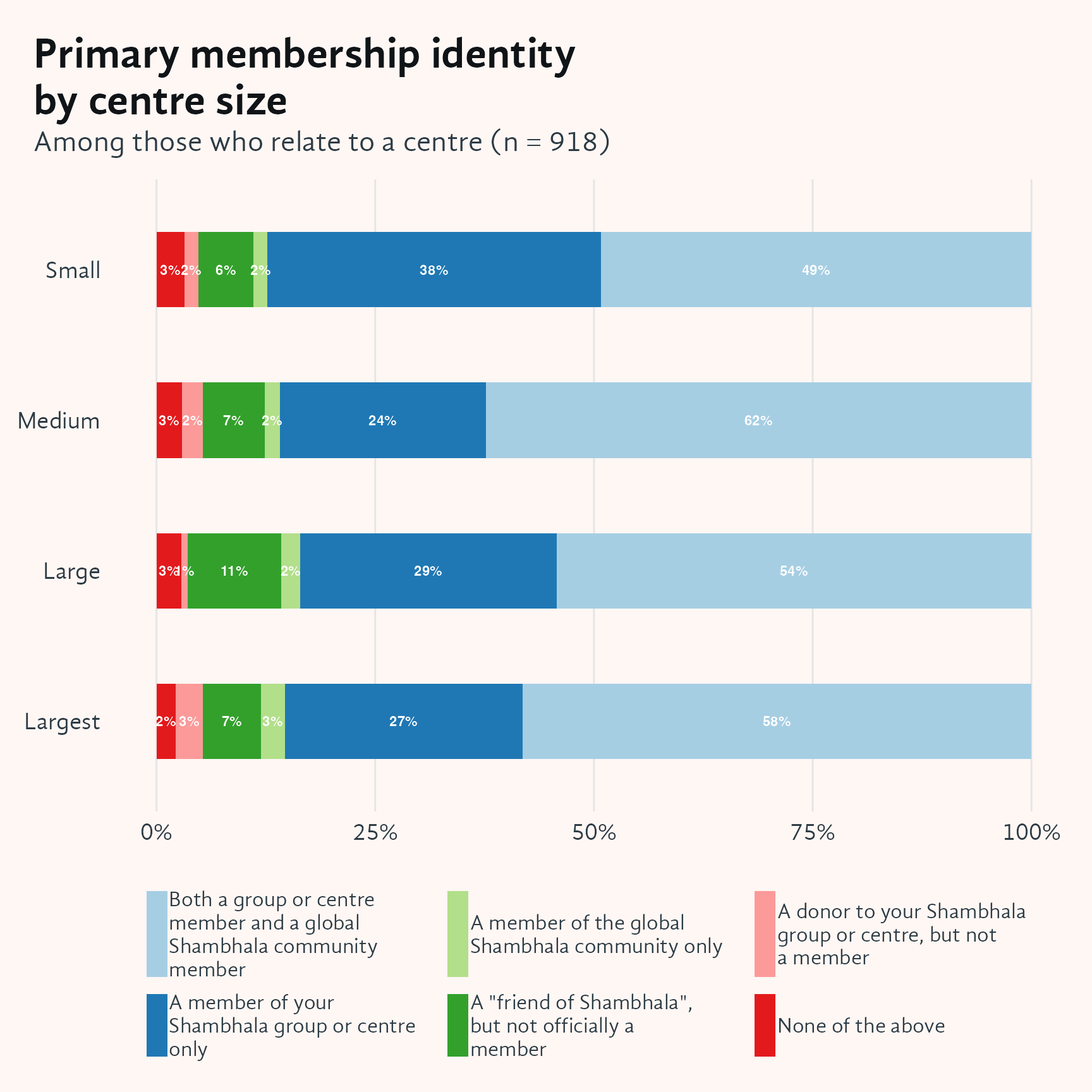
Stacked horizontal bar chart showing primary membership identity broken down by centre size. Four centre sizes appear on the y-axis (Small, Medium, Large, Largest); each bar is divided into colored segments for the six membership identity categories. Members of the largest and medium centres are more likely to identify as members of both their local centre and the global community, while members of smaller centres more frequently identify as centre members only.
Figure 5

Members of the largest and medium centres are the most likely to see themselves as members of both their local centre and the global Shambhala community. Members of smaller centres more often identify as centre members only.

6 Sense of belonging by centre size among those who relate to a centre

Grouped vertical bar chart showing sense of belonging by centre size, restricted to those who relate to a centre. Centre sizes (Small, Medium, Large, Largest) appear on the x-axis; within each group, three side-by- side bars represent low (0-3), medium (4-6), and high (7-10) belonging scores. Members of medium and large centres report the highest belonging scores, and these same centre sizes show the greatest proportion of respondents who identify as members of both their local centre and the global Shambhala community.
Figure 6

Respondents from medium and large centres report the strongest sense of belonging among those who relate to a centre. These are also the size groups where members are most likely to identify as belonging to both their local centre and the global Shambhala community.

7 Perceptions of membership of those who do not relate to a centre

Horizontal bar chart showing how respondents who do not relate to a Shambhala centre perceive their own membership. Membership identity categories are listed on the y-axis; the x-axis shows percentage. Only about one third of non-relating respondents consider themselves members of Shambhala, illustrating how the absence of a centre connection substantially reduces the likelihood of identifying as a member.
Figure 7

Only about a third of those who do not relate to a Shambhala centre consider themselves members of Shambhala. Not having a centre connection substantially reduces the likelihood of identifying as a member.

8 Primary membership identity by time period joined for those who do not relate to a centre

Stacked horizontal bar chart showing membership identity by time period joined, restricted to respondents who do not relate to a centre. Four joining-era cohorts appear on the y-axis (70s-80s, 90s-2007, 2008-2017, and 2018 or later); each bar is divided into colored segments for membership identity categories. Among those not connected to a centre, longer-tenured members (70s-80s cohort) are substantially more likely to still consider themselves Shambhala members, while newer entrants are less likely to identify as members at all.
Figure 8

Among those not connected to a centre, older cohorts (those who joined in the 1970s and 1980s) are substantially more likely to still consider themselves Shambhala members. Those who joined more recently are less likely to identify as members at all.

9 Participation in Centre Decisions
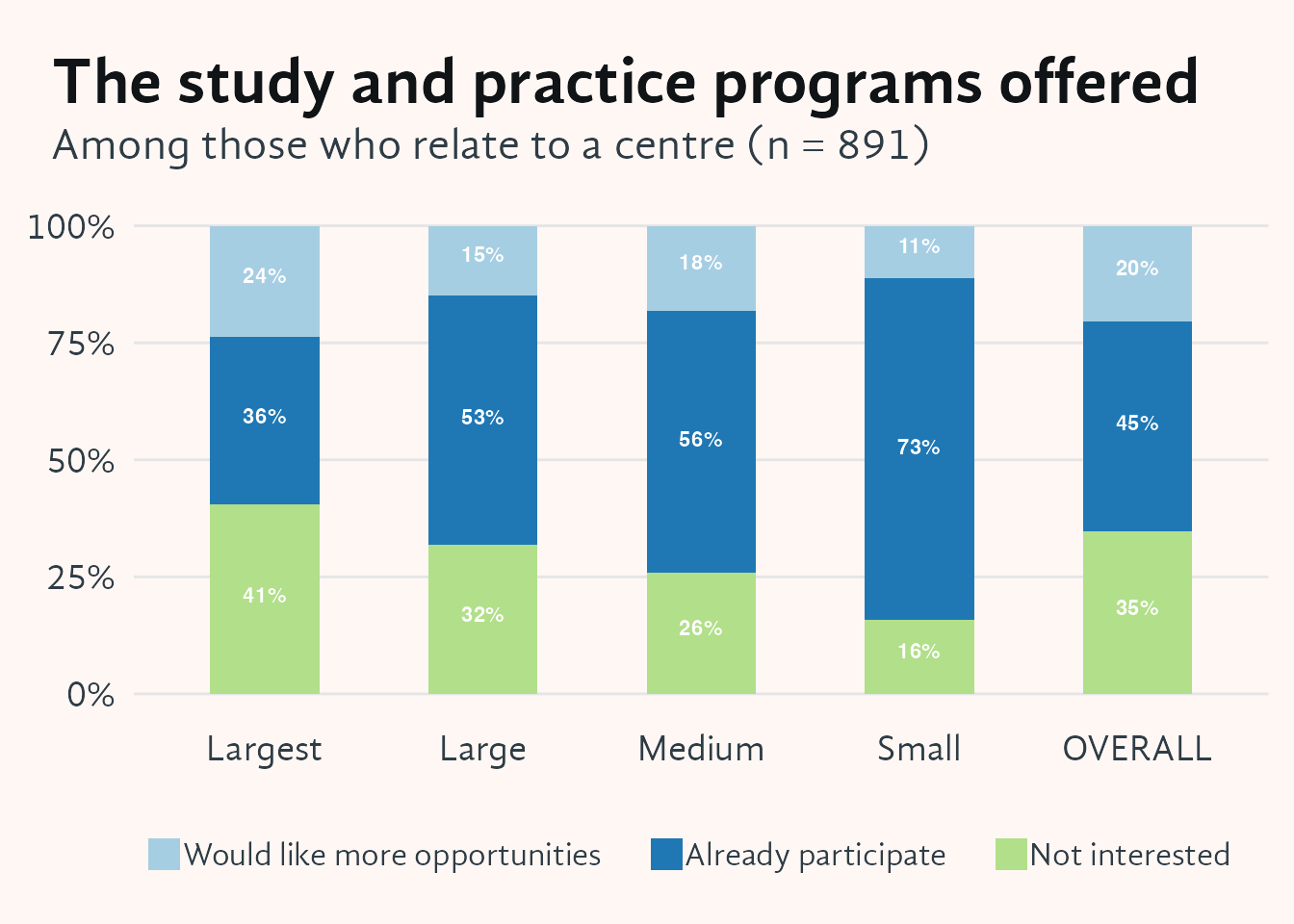
Stacked vertical bar chart showing respondents' participation in decisions about study and practice programs, broken down by centre size on the x-axis (Small, Medium, Large, Largest, and an Overall bar). Each bar is divided into three segments: already participates, would like more opportunities, and not interested. Small centre members report the highest rates of already participating in these decisions, with participation levels roughly double those seen at the largest centres.
Figure 9

Small centre members are the most likely to already participate in decisions about study and practice programs, with participation rates roughly double those at the largest centres.

Stacked vertical bar chart showing respondents' participation in decisions about social events and other activities, broken down by centre size (Small, Medium, Large, Largest, Overall). Each bar is divided into segments for already participates, would like more opportunities, and not interested. The pattern mirrors other decision areas: small centre members participate most, and their participation rate is markedly higher than that of members at the largest centres.
Figure 10

The pattern for social events mirrors that for study and practice: small centre members participate most actively, and the gap between small and large centres is substantial.
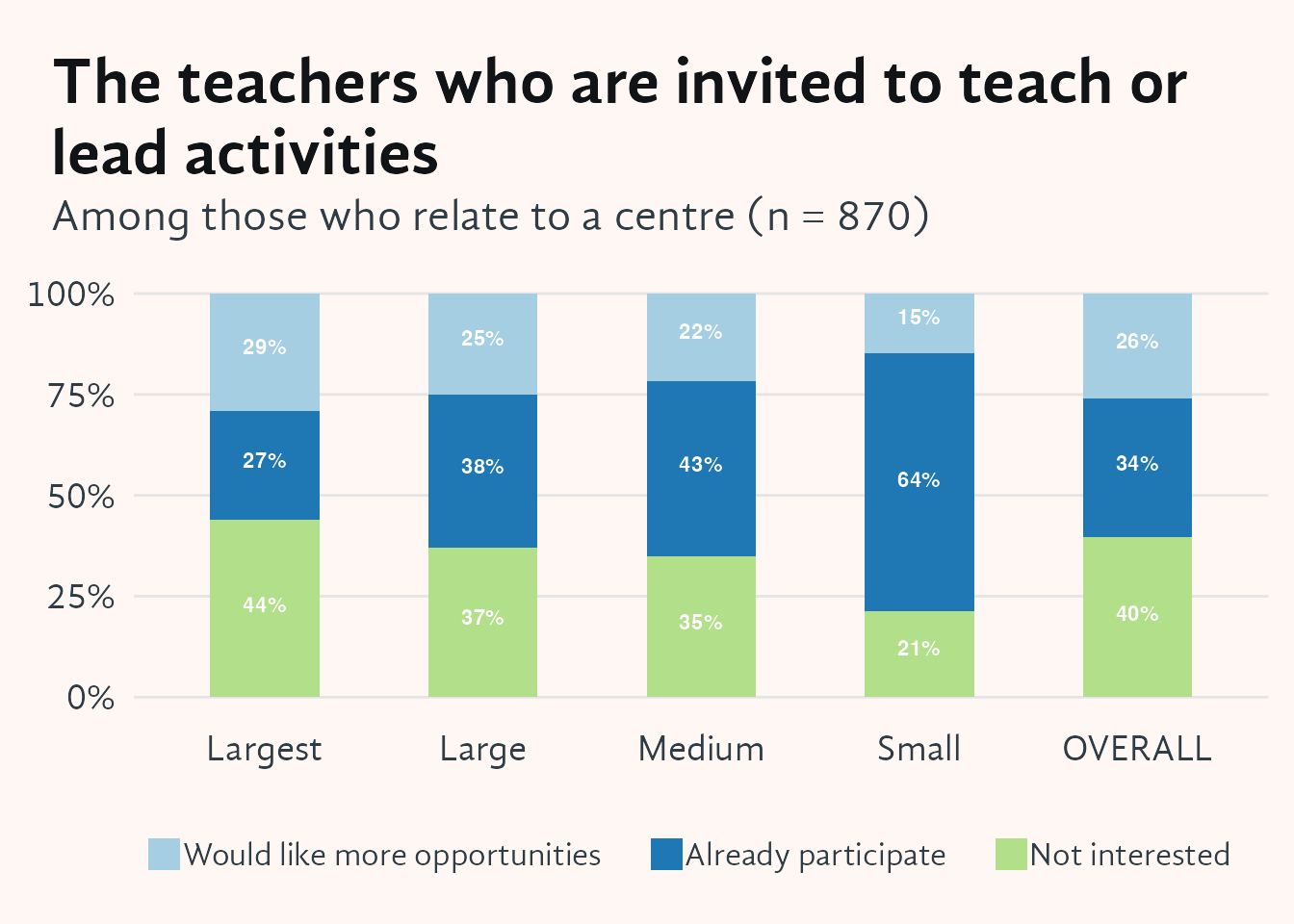
Stacked vertical bar chart showing respondents' participation in decisions about which teachers are invited to teach or lead activities, broken down by centre size (Small, Medium, Large, Largest, Overall). The three segments represent already participates, would like more opportunities, and not interested. As with other decision areas, small centre members are the most likely to already participate in teacher selection, while members of the largest centres are more likely to report no interest in participating.
Figure 11

Small centre members are the most likely to already have a hand in decisions about which teachers are invited. At the largest centres, members are more likely to report no interest in participating in teacher selection.
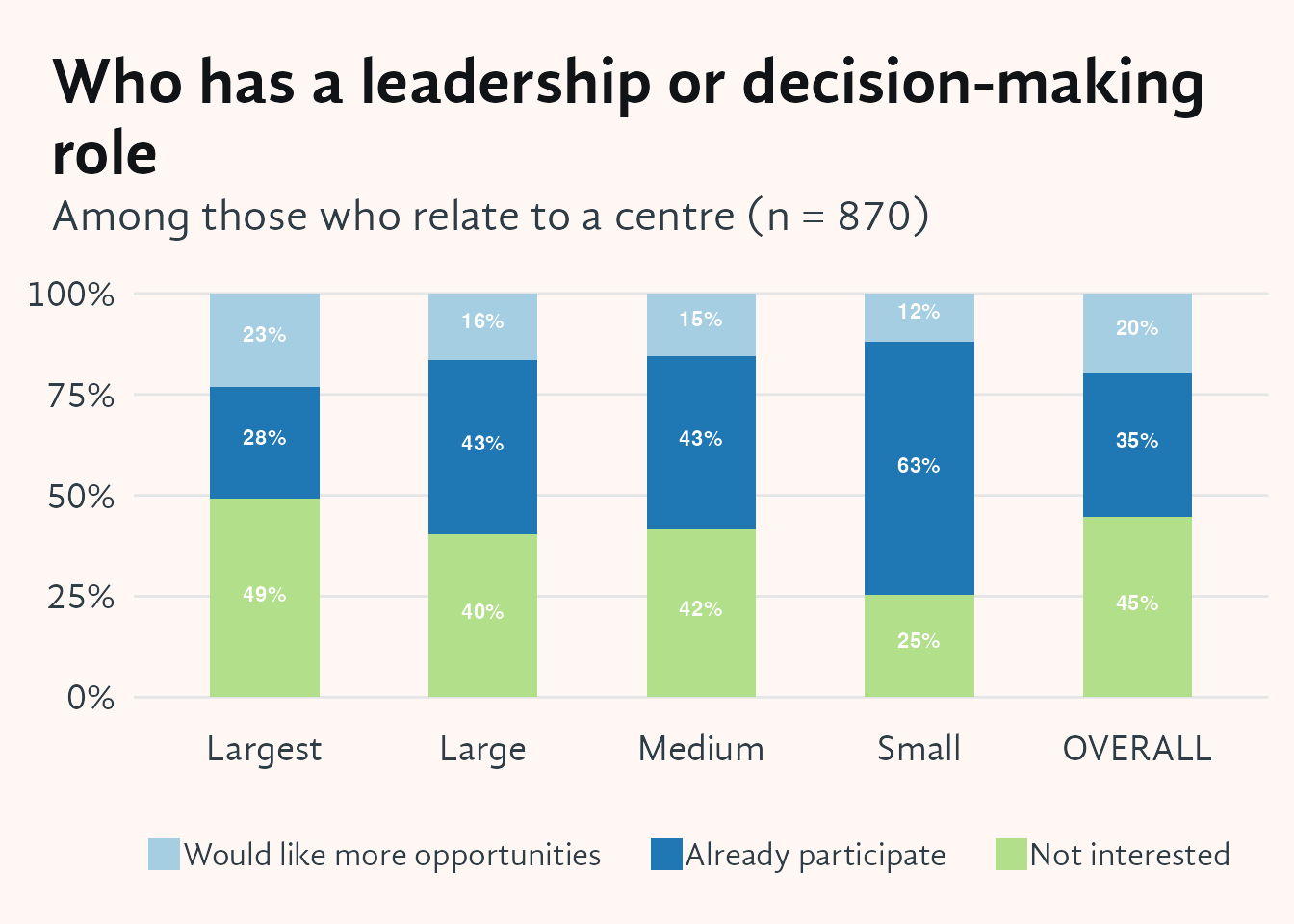
Stacked vertical bar chart showing respondents' participation in decisions about who holds leadership or decision-making roles, broken down by centre size (Small, Medium, Large, Largest, Overall). Each bar is divided into segments for already participates, would like more opportunities, and not interested. Small centre members again show the highest participation rates, with a large gap compared to the largest centres, where members are notably less likely to participate and more likely to report disinterest.
Figure 12

Small centre members are the most engaged in leadership decisions, with participation rates far higher than those at the largest centres, where disinterest in participating is also most common.
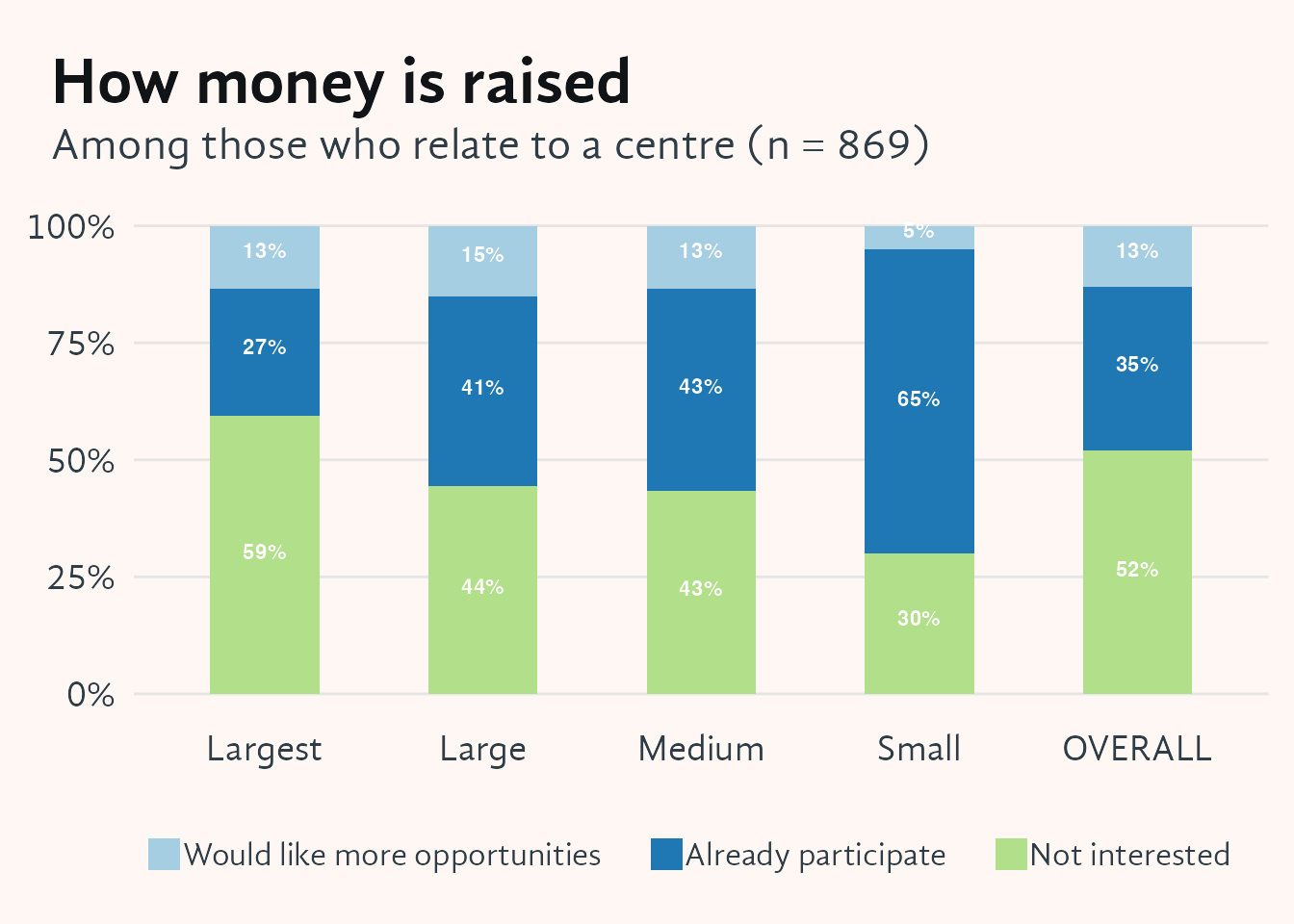
Stacked vertical bar chart showing respondents' participation in decisions about how money is raised, broken down by centre size (Small, Medium, Large, Largest, Overall). Three segments represent already participates, would like more opportunities, and not interested. Small centre members are the most actively involved in fundraising decisions, with participation rates more than double those of the largest centre members.
Figure 13

Small centre members are the most actively involved in fundraising decisions, with participation rates more than double those at the largest centres.
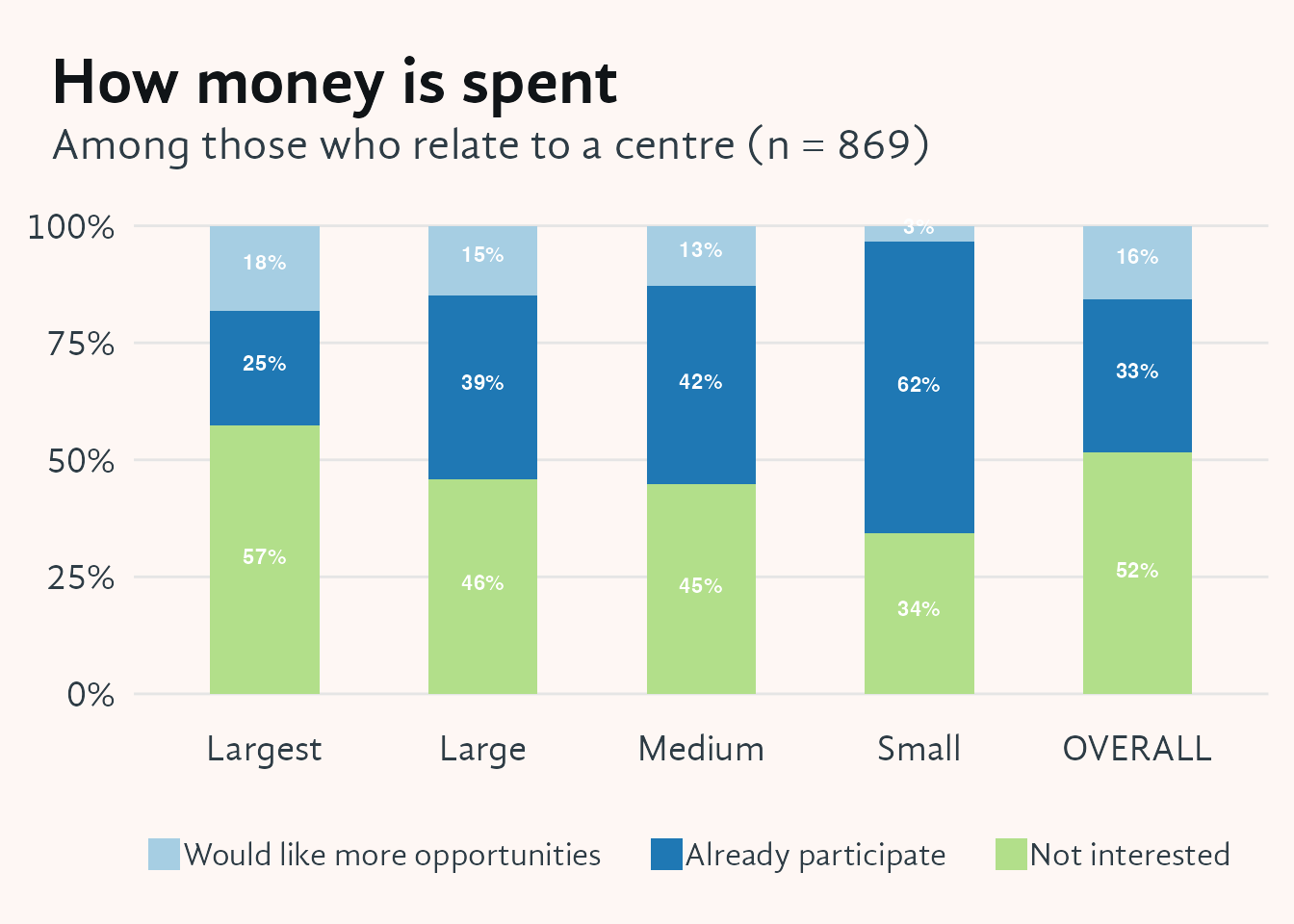
Stacked vertical bar chart showing respondents' participation in decisions about how money is spent, broken down by centre size (Small, Medium, Large, Largest, Overall). The three segments represent already participates, would like more opportunities, and not interested. The size-based gradient in participation is consistent with other financial and governance topics: small centre members are most involved, and the gap to the largest centres is pronounced.
Figure 14

Participation in spending decisions follows the same size-based pattern: small centre members are the most involved, and the gap compared to the largest centres is pronounced.
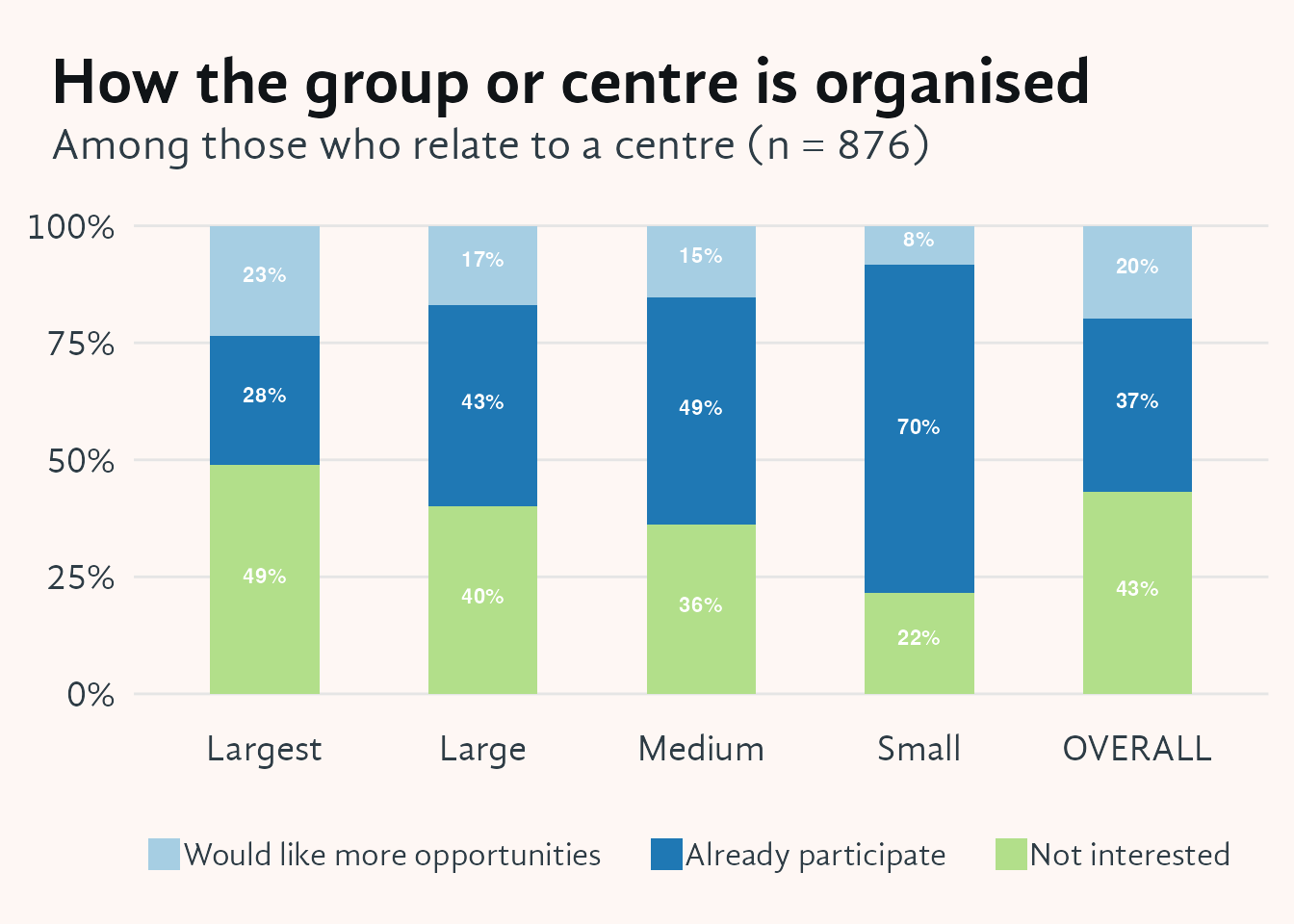
Stacked vertical bar chart showing respondents' participation in decisions about how their group or centre is organised, broken down by centre size (Small, Medium, Large, Largest, Overall). Three segments represent already participates, would like more opportunities, and not interested. Small centre members show the highest participation in organisational decisions across all topics covered in this series, while members of the largest centres are the least likely to participate and the most likely to report no interest in doing so.
Figure 15

Participation in organizational decisions follows the same size-based pattern: small centre members are the most involved, and the gap compared to the largest centres is pronounced.

Overall, members of Shambhala’s smallest centres participate most in decisions. This gap is striking: more than twice as many small centre members reported participating in decisions compared to members of the largest centres. Meanwhile, members of larger centres generally said they did not want more involvement in decision-making.

10 Non-Affiliated Members
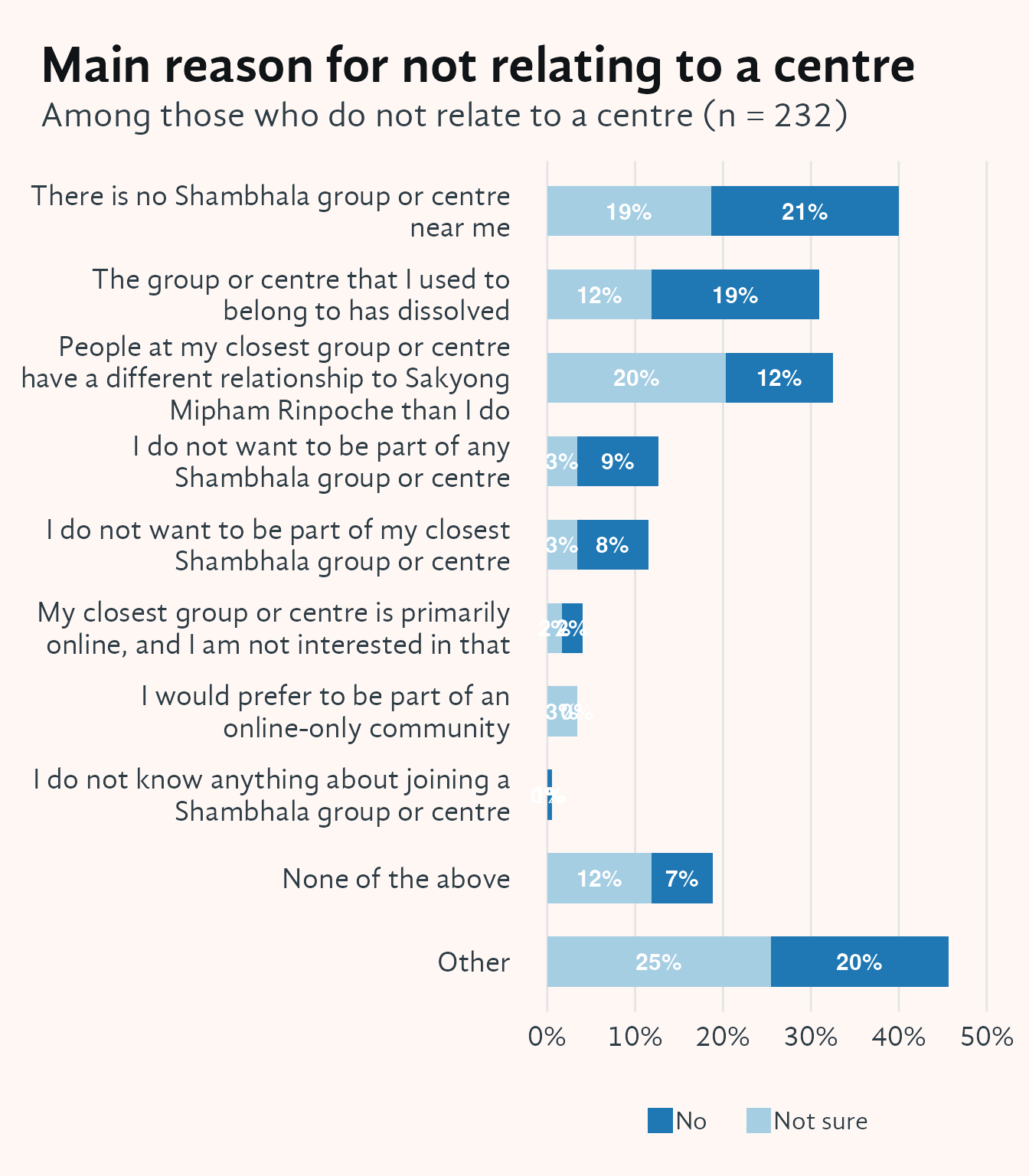
Stacked horizontal bar chart showing the main reasons respondents do not relate to a Shambhala centre, split by those who answered No and those who are Not sure. Reasons appear on the y-axis sorted by combined frequency; the x-axis shows percentage up to 50%. Bars are divided into two colour-coded segments for the No and Not sure groups. No nearby centre is the most common reason (about 21%), followed by centre dissolution (17%) and a different relationship with the Sakyong Mipham (14%).
Figure 16
Table 1
Main reason for not relating to a centre
Among those who do not relate to a centre (n = 232)
Relate to a centre - No Relate to a Centre - Not Sure Overall Percentage
Other 20% 25% 22%
There is no Shambhala group or centre near me 21% 19% 21%
The group or centre that I used to belong to has dissolved 19% 12% 17%
People at my closest group or centre have a different relationship to Sakyong Mipham Rinpoche than I do 12% 20% 14%
I do not want to be part of any Shambhala group or centre 9% 3% 8%
I do not want to be part of my closest Shambhala group or centre 8% 3% 7%
My closest group or centre is primarily online, and I am not interested in that 2% 2% 2%
I would prefer to be part of an online-only community 0% 3% 1%
I do not know anything about joining a Shambhala group or centre 1% 0% 0%
None of the above 7% 12% 8%

95% of those who do not relate to a centre now had previously been a member of a center.

The table shows the reasons 232 survey respondents do not relate to a Shambhala group or centre, sorted by the “No” and “Not sure” combined. Top reasons: no nearby centre (21%), dissolved group or centre (17%), followed by relationship differences with Sakyong Mipham Rinpoche (14%).

Of the 22% who responded “other”, 46 offered additional comments. These comments fell into two main categories. The first described various experiences of alienation, either from a local group or centre or from Shambhala generally:

Examples…

I am not sure yet if I want to still be part of a Shambhala centre. It brings up a lot of emotion and grief in me when I go there.

I have a hard time feeling connected to the people.

I have yet to feel that Shambhala has found its voice or footing and until it does I do not want to further jeopardize mine and others spiritual development.

The second comment category was from people who were too busy and/or found that the center was not appealing, conveniently located, or open when they could participate:

Examples…

My former center is only able to be open at times I find difficult to attend.

The centre closest to me is fragmented to multiple groups with differing focuses.

1) my work schedule is an obstacle 2) After 25 years, I feel very comfortable not being active right now.

45 of the 238 respondents to the question of whether they are interested in organised efforts to help them connect with others in Shambhala offered additional comments. All described varying degrees of alienation from Shambhala, or well-wishes but no interest in deeper involvement.

11 Do you think of yourself as a member of Shambhala now?
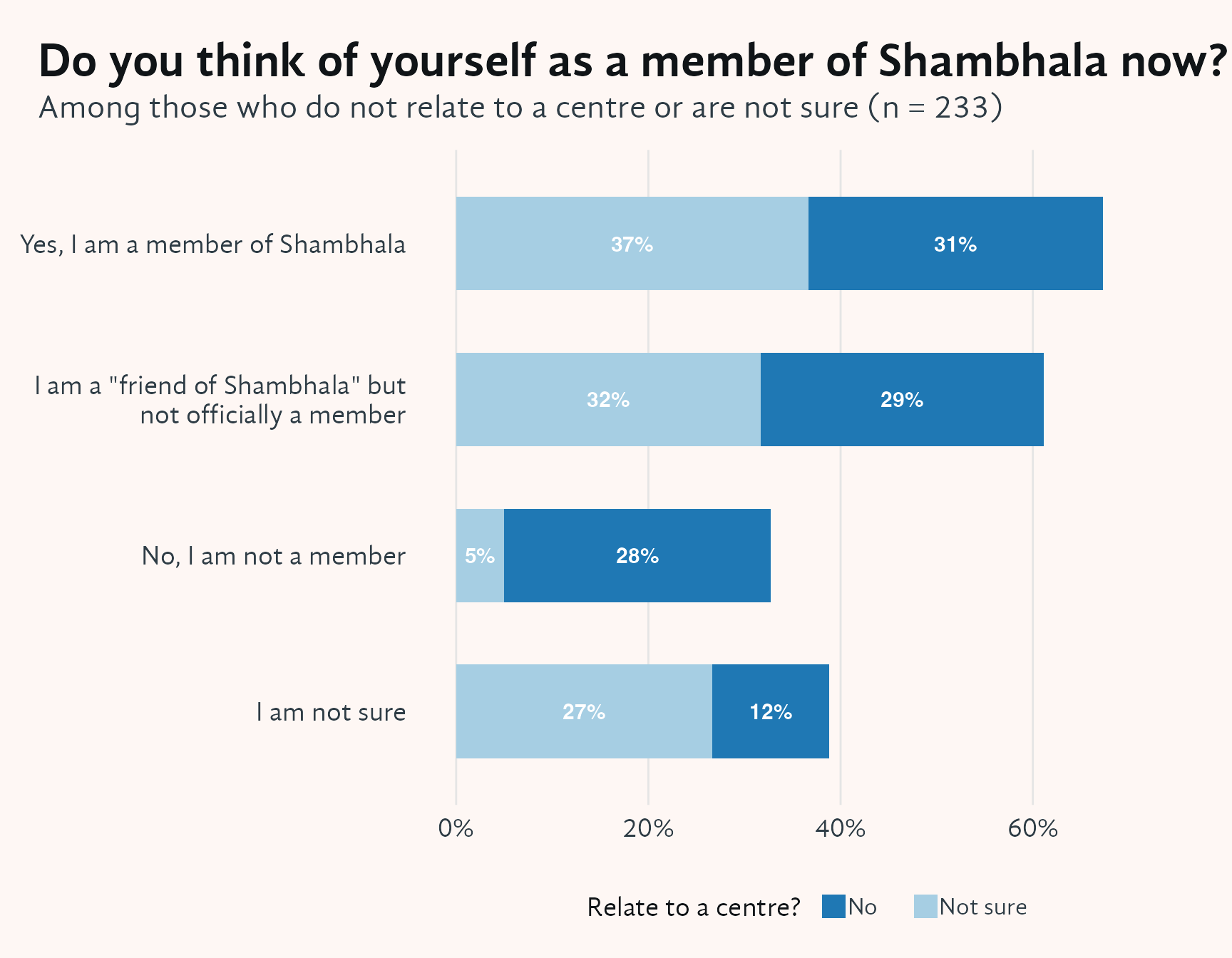
Stacked horizontal bar chart showing how respondents who do not relate to a Shambhala centre perceive their own membership, split by those who said No and those who are Not sure. Membership identity categories appear on the y-axis; the x-axis shows percentage up to 75%. Bars are colour-coded for the two groups. A surprisingly large share — about one third or more — still consider themselves Shambhala members or friends despite having no active centre connection.
Figure 17
Table 2
Do you think of yourself as a member of Shambhala now?
Among those who do not relate to a centre (n = 232)
q0071 Relate to a centre - No Relate to a Centre - Not Sure Overall Percentage
Yes, I am a member of Shambhala 31% 37% 32%
I am a "friend of Shambhala" but not officially a member 29% 32% 30%
No, I am not a member 28% 5% 22%
I am not sure 12% 27% 16%

A surprising percentage of how who do not related to a group or centre reported that they were either members or friends of Shambhala.

12 Interest in efforts to help connection among those who are not affiliated with a group or centre
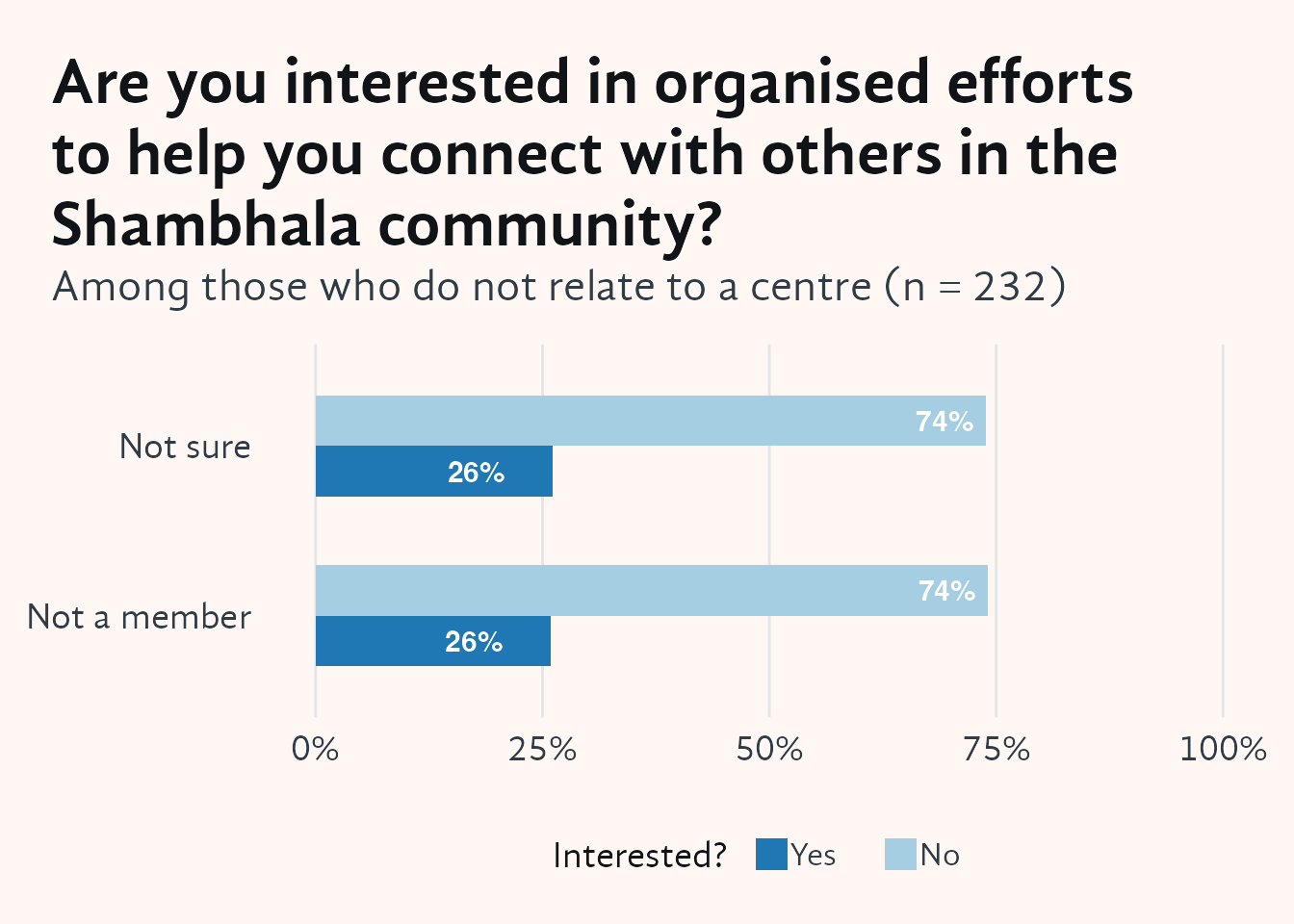
Grouped horizontal bar chart showing interest in organised efforts to connect with others in the Shambhala community, split by whether respondents said they do not relate to a centre (Not a member) or are not sure (Not sure). Two bars per group represent Yes and No responses, with percentage labels. The majority of both groups are not interested in organised connection efforts, reflecting varying degrees of disengagement from the broader Shambhala community.
Figure 18
Table 3
Are you interested in organised efforts to help you connect with others in the Shambhala community?
Among those who do not relate to a centre (n = 232)
Member of Shambhala? Yes No
Not a member 25.9% 74.1%
Not sure 26.1% 73.9%

A majority of those who do not relate to a group or centre are not interested in organized efforts to connect with others in the Shambhala community.

13 Interest in different ways to connect with others in the Shambhala community

Table 4
How helpful would each of these be for helping you to connect more with others in Shambhala?
Among those who do not relate to a centre and responded to this question (n = 39)
Very helpful Somewhat helpful Not helpful or not interested
Being part of a virtual Shambhala center that would gather consistently online 37% 37% 26%
Connecting to a Shambhala center remotely 32% 36% 32%
Affiliating with other groups in Shambhala, such as the Dorje Kasung or Touching the Earth 27% 39% 34%
Participating as a volunteer in a Shambhala activity 40% 33% 26%

The responses here show strong interest among respondents for the itemised initiatives to help them connect more to others in Shambhala.