Community Purpose and Values

1 Importance of Shambhala features/purposes

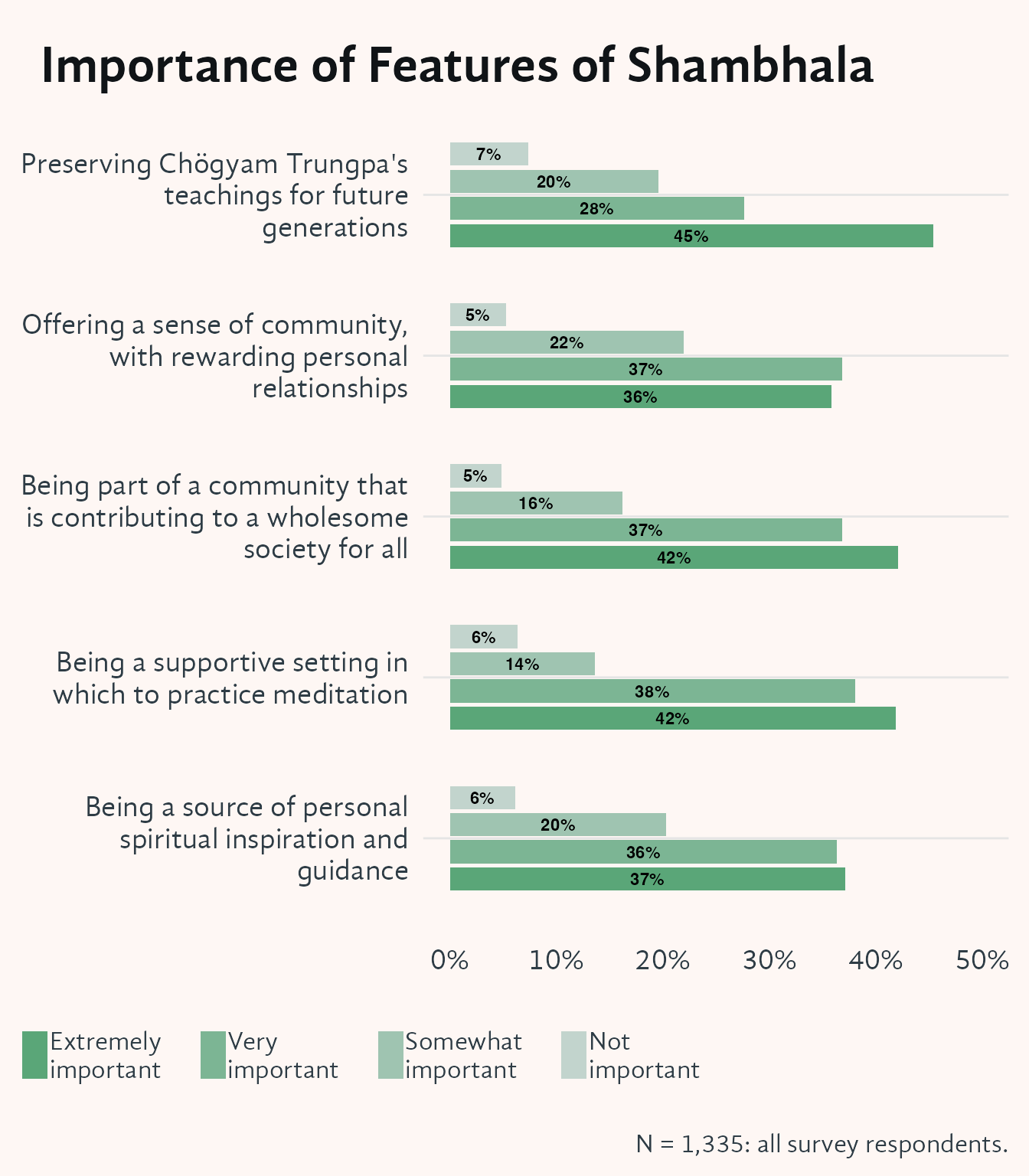
Dodged horizontal bar chart. Five Shambhala features appear on the vertical axis (spiritual inspiration, group meditation, community and relationships, contributing to a wholesome society, preserving Chögyam Trungpa's teachings). Four grouped bars per feature show the share of respondents rating each level (Not, Somewhat, Very, Extremely important), scaled to a maximum of 50%. Between 70% and 80% of respondents rated every feature as Very or Extremely important, showing remarkably consistent high value across all five dimensions.
Figure 1

Overall, between 70% and 80% of respondents rated every one of these five features as very or extremely important, a level of consensus that holds across all five dimensions, even though small variations are seen across cohorts, Almost all survey respondents reported that spirituality serves as a guide or framework for making choices in their lives, though newer members expressed this with less certainty. Nearly 85% reported having studied Shambhala teachings specifically.

2 Comparisons across generations

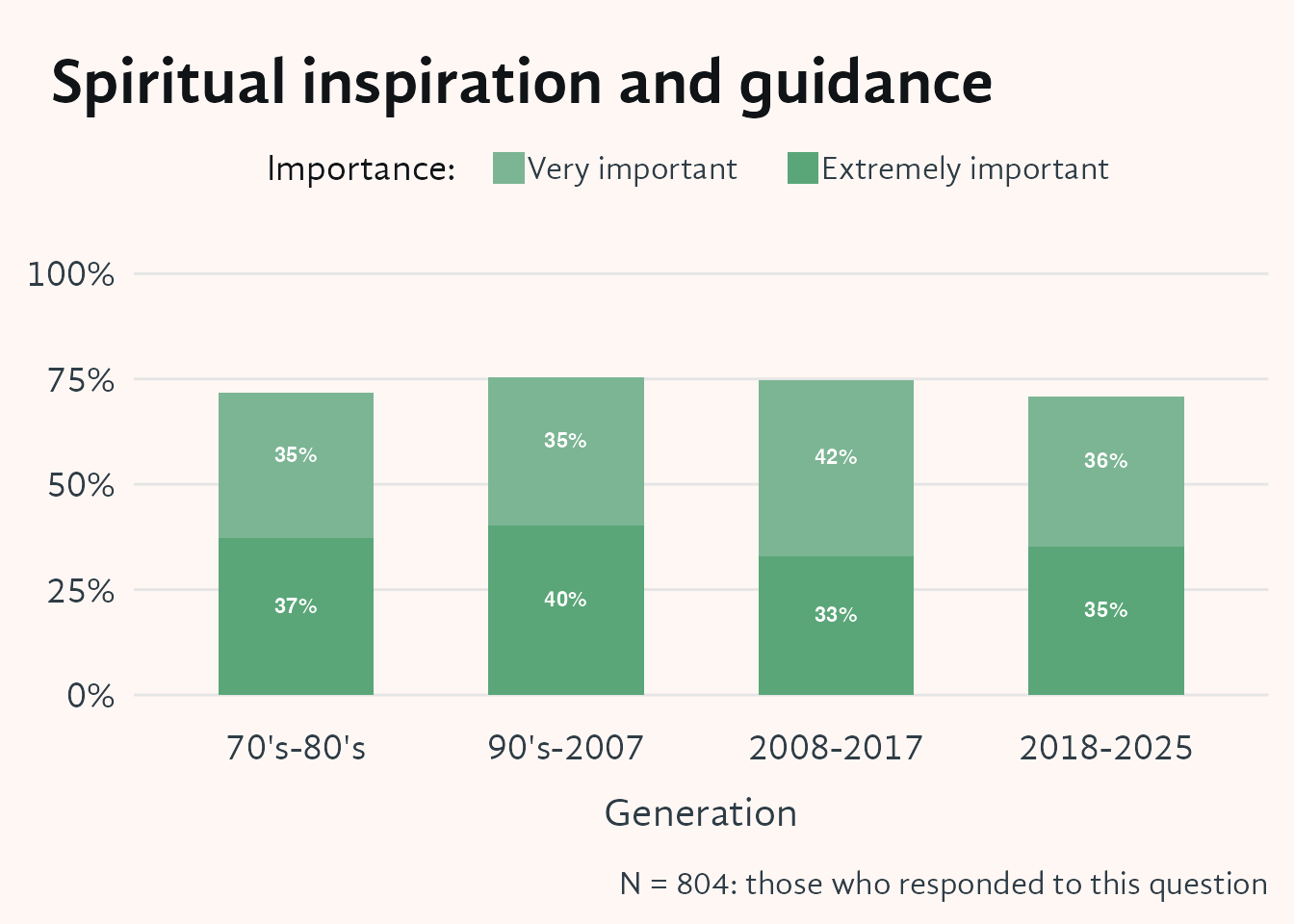
Stacked bar chart showing the percentage of respondents who rated "Spiritual inspiration and guidance" as Very or Extremely important, split into two stacked segments per bar, across four joining-era cohorts on the x-axis (70's–80's, 90's–2007, 2008–2017, 2018–2025). Importance of spiritual inspiration is consistently high across all cohorts, with little variation by generation.
Figure 2

Valuing Shambhala as a source of spiritual inspiration and guidance is consistently high across all four entry cohorts, with little variation by generation. This is the one dimension where the different generations show nearly identical levels of commitment.
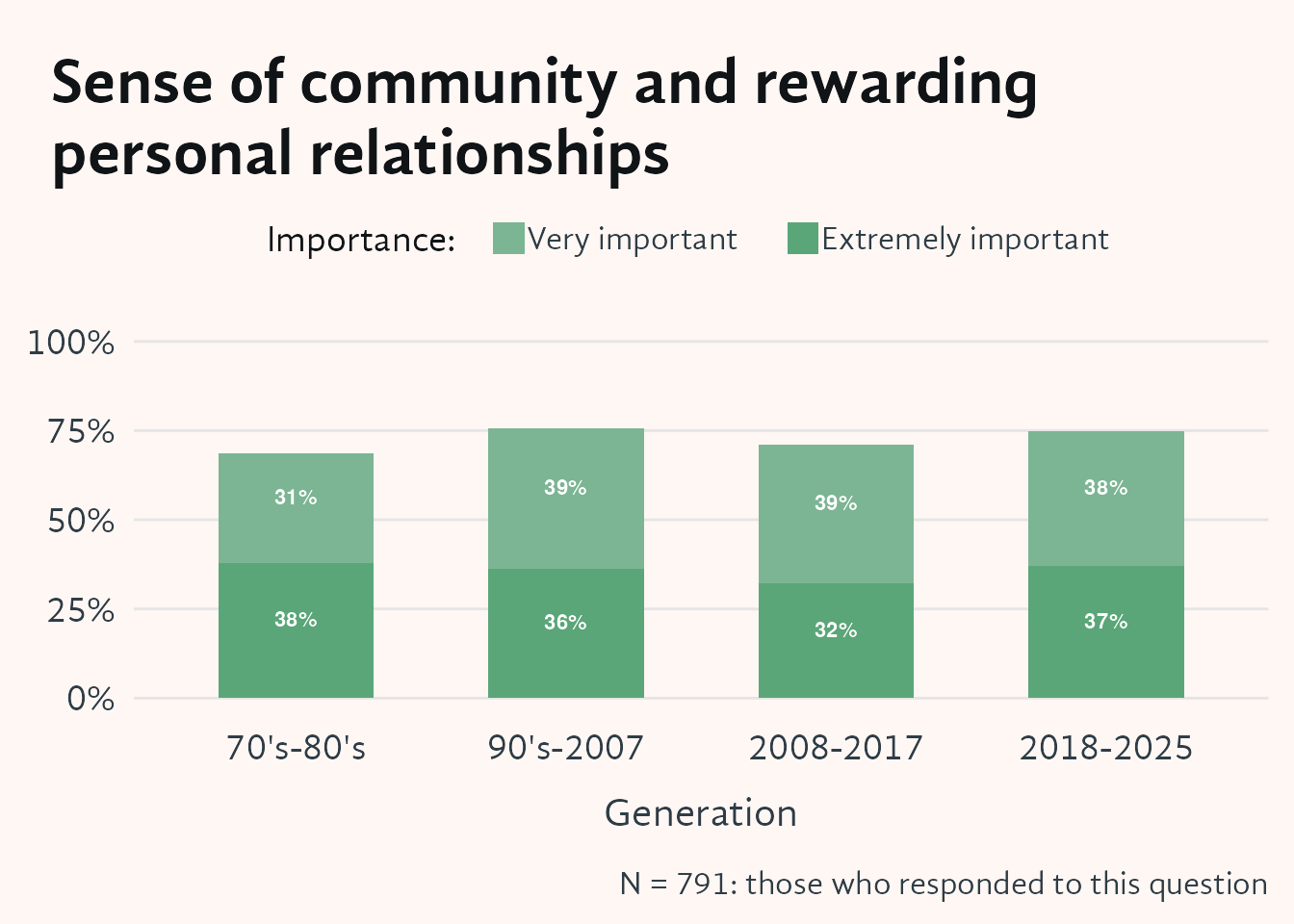
Stacked bar chart showing the percentage of respondents who rated "Sense of community and rewarding personal relationships" as Very or Extremely important, across four joining-era cohorts on the x-axis (70's–80's, 90's–2007, 2008–2017, 2018–2025). Each bar is divided into Very and Extremely important segments. Valuing community and personal relationships is high and consistent across all cohorts.
Figure 3

Sense of community and rewarding personal relationships is consistently valued across all entry cohorts, similar in pattern to spiritual inspiration. Neither older nor newer members stand out on this dimension.
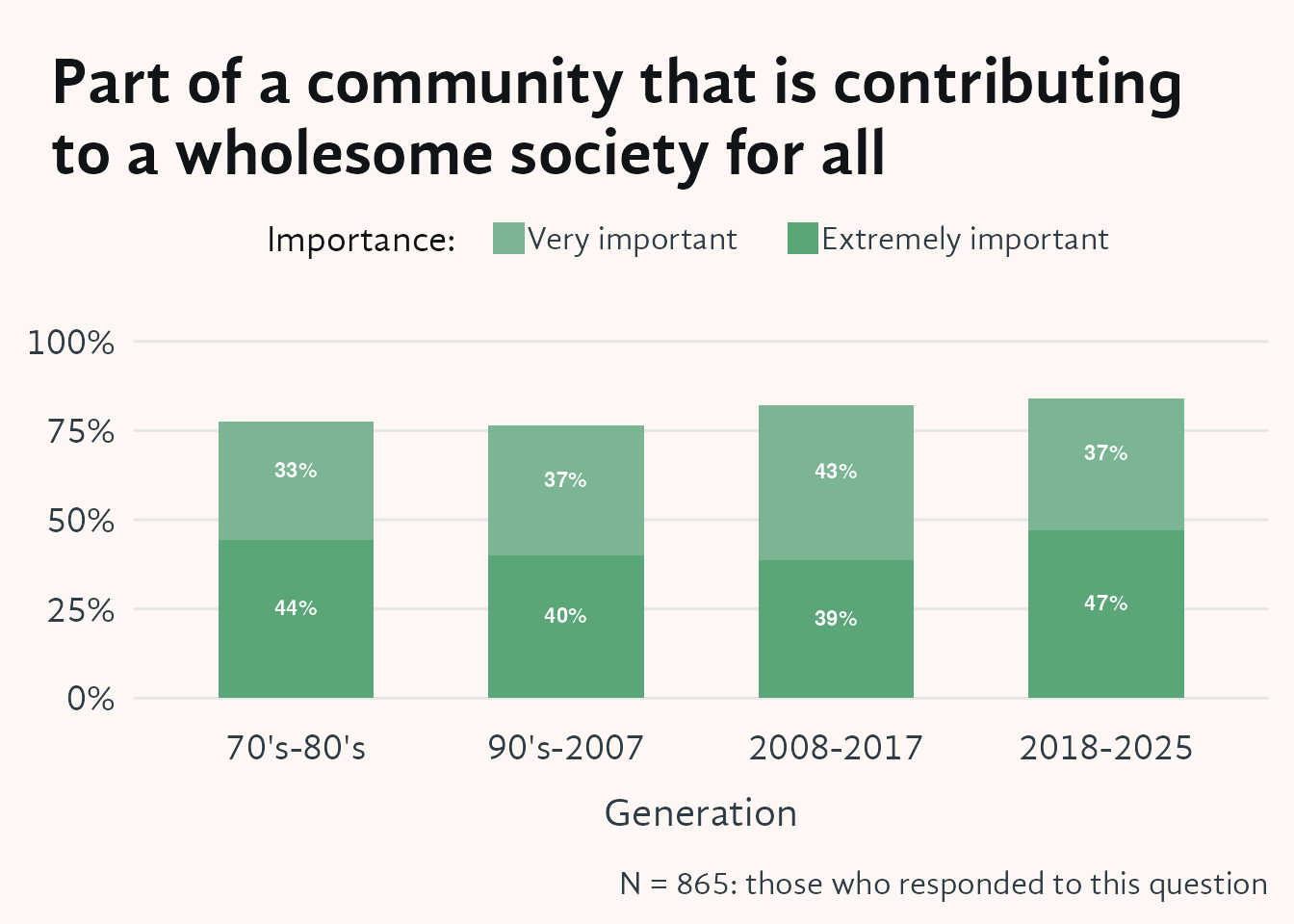
Stacked bar chart showing the percentage of respondents who rated "Part of a community that is contributing to a wholesome society for all" as Very or Extremely important, across four joining-era cohorts on the x-axis (70's–80's, 90's–2007, 2008–2017, 2018–2025). The newest cohort (2018–2025) places noticeably more importance on contributing to a wholesome society than the oldest cohort (70's–80's).
Figure 4

Those who joined since 2018 place more importance on Shambhala’s role in contributing to a wholesome society than those who joined in the 1970s and 80s.
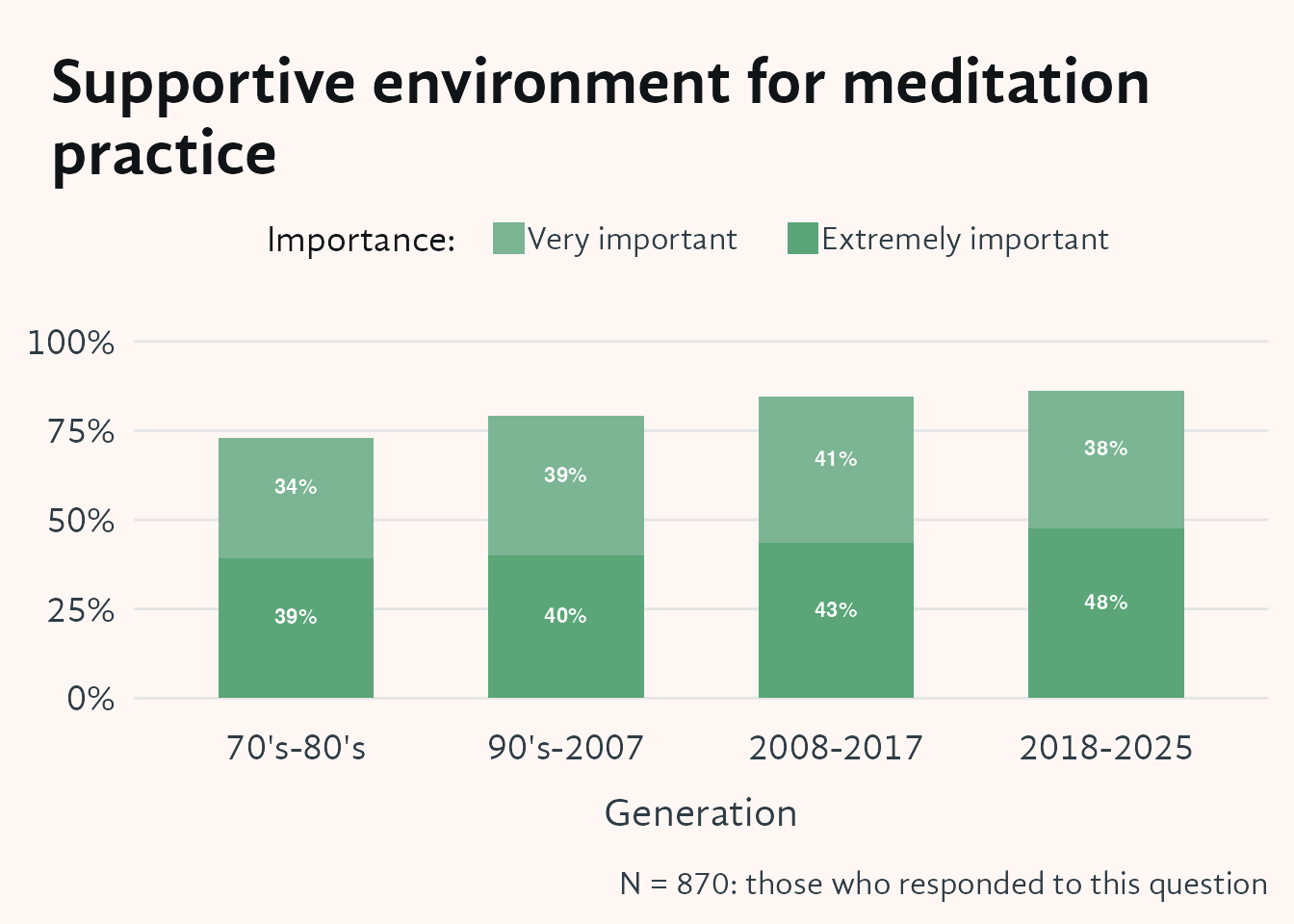
Stacked bar chart showing the percentage of respondents who rated "Supportive environment for meditation practice" as Very or Extremely important, across four joining-era cohorts on the x-axis (70's–80's, 90's–2007, 2008–2017, 2018–2025). Newer members place significantly more importance on Shambhala as a supportive meditation environment than those who joined in the 1970s and 1980s.
Figure 5

Newer members are substantially more likely to rate Shambhala’s role as a supportive meditation environment as very or extremely important. The contrast between the 2018–2025 cohort and the 1970s–80s cohort suggests different expectations of what a spiritual community should provide.

Stacked bar chart showing the percentage of respondents who rated "Preserving Chögyam Trungpa's teachings for future generations" as Very or Extremely important, across four joining-era cohorts on the x-axis (70's–80's, 90's–2007, 2008–2017, 2018–2025). Importance of preserving Trungpa's teachings declines sharply with more recent cohorts, with the oldest cohort rating it far more highly than those who joined since 2018.
Figure 6

Preserving Chögyam Trungpa’s teachings for future generations matters most to those who joined in the 1970s and 80s and declines steadily with each successive cohort. Among those who joined since 2018, it is the least important of the five features by a wide margin.

Members most highly valued spiritual inspiration, rewarding relationships, and sense of community as reasons for participating in Shambhala. Newer members placed relatively greater importance on clear pathways for practice and access to supportive practitioner groups.

3 Likelihood to recommend Shambhala to friend/colleague

Vertical bar chart showing the distribution of net recommender score buckets on the x-axis (0 to 3, 4 to 6, 7 to 8, 9 to 10) and percentage of respondents on the y-axis. The 9-to-10 bucket is the tallest bar, indicating that the largest share of 2026 survey respondents reported high willingness to recommend Shambhala to a friend or colleague.
Figure 7

The largest share of 2026 survey respondents — close to one third — would give Shambhala a score of 9 or 10 when asked how likely they are to recommend it to a friend or colleague. Eighteen percent would give a score of 3 or lower.

4 Likelihood to recommend Shambhala to friend/colleague by year started in Shambhala
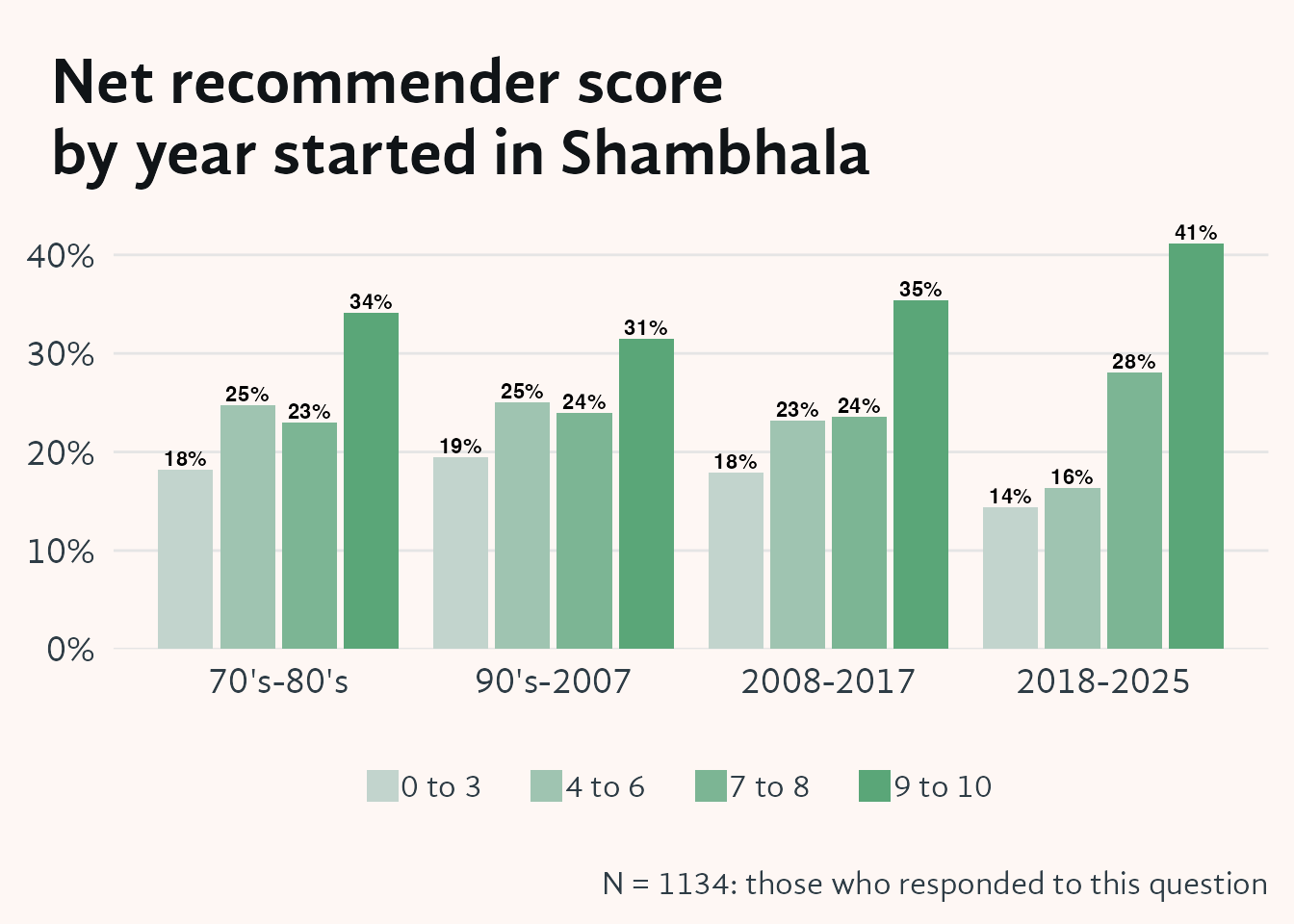
Dodged vertical bar chart. Four joining-era cohorts appear on the x-axis (70's–80's, 90's–2007, 2008–2017, 2018–2025). Within each cohort, four colour-coded bars show the percentage of respondents in each net recommender score tier (0–3, 4–6, 7–8, 9–10). The newest cohort (2018–2025) has the highest share of 9–10 scores, and the majority of respondents across all cohorts scored 7 or above.
Figure 8

Across all four joining-era cohorts, the majority of respondents would give Shambhala a recommender score of 7 or higher. The 2018–2025 cohort has the highest concentration of top scores (9–10), while older cohorts show slightly more spread across the lower tiers.

5 Likelihood to recommend Shambhala to friend/colleague by survey year
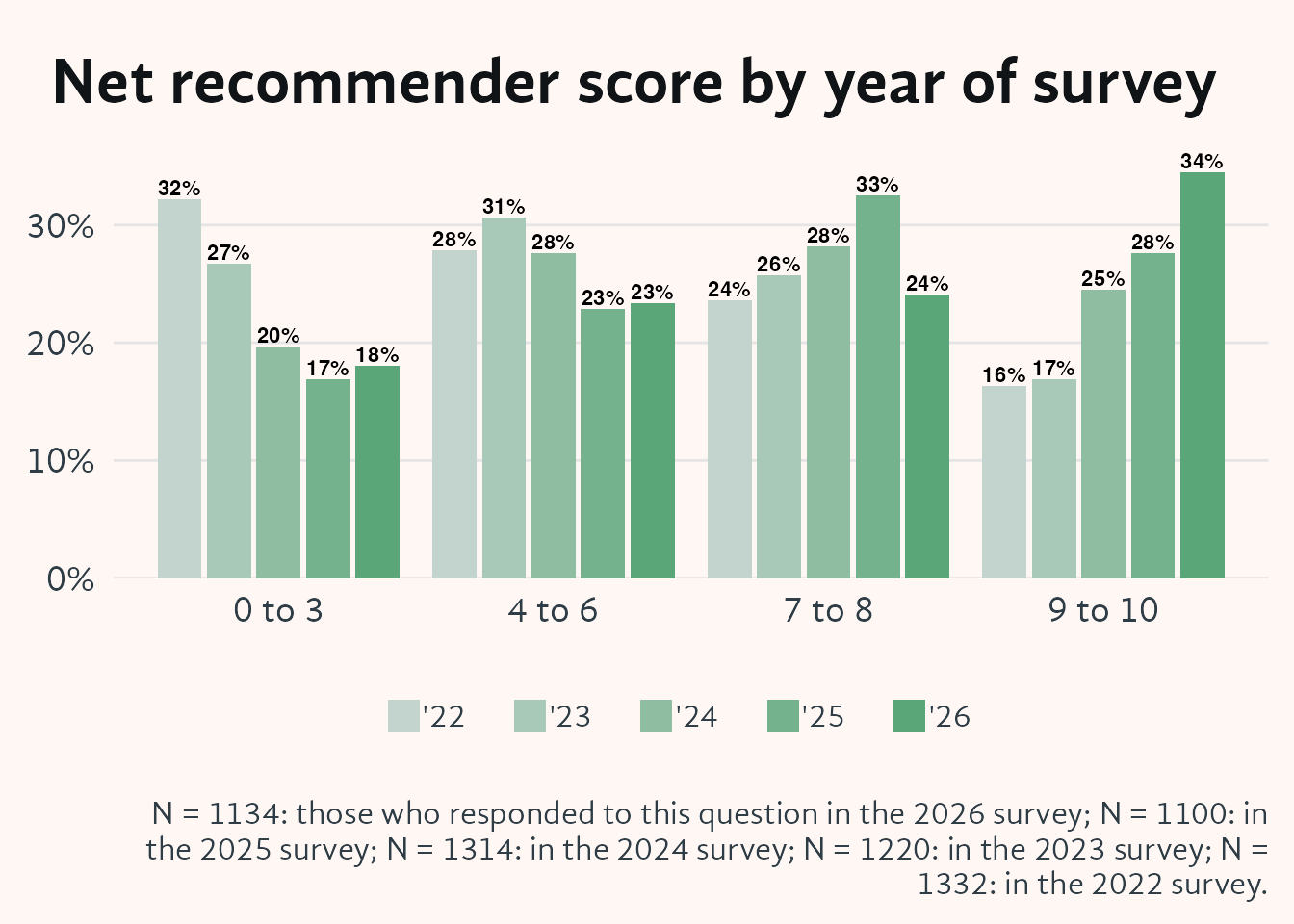
Dodged vertical bar chart showing the distribution of net recommender score buckets (0–3, 4–6, 7–8, 9–10) on the x-axis and percentage of respondents on the y-axis, with one bar per survey year (2022 through 2026) shown in different shades of green. The 9–10 bucket has grown substantially from 2022 to 2026 — more than doubling — while the 0–3 bucket has roughly halved over the same period, indicating a clear shift toward greater willingness to recommend Shambhala across survey years.
Figure 9

Over the survey years, the proportion of low recommender scores has substantially decreased and the proportion of high scores has substantially increased. The number of respondents rating their sense of belonging as 9 to 10 in 2026 is by far the highest over the four years, and more than twice as many as in 2022. Similarly, for the lowest scores, the number rating at this level has almost halved. The number of respondents rating their sense of belonging as moderate to high has remained fairly consistent.

6 Likelihood to recommend Shambhala to friend/colleague by whether they relate to a centre

Dodged vertical bar chart showing the distribution of net recommender score buckets (0–3, 4–6, 7–8, 9–10) on the x-axis and percentage of respondents on the y-axis, with two bars per bucket colored by whether the respondent relates to a centre or does not. Those who do not relate to a centre give far fewer high scores (9–10) and a larger share of low scores, suggesting reduced willingness to recommend Shambhala among members without an active centre connection.
Figure 10

Those who do not relate to a Shambhala centre give substantially fewer high recommender scores than those who do. Centre-connected members are far more likely to score in the 9–10 range, while those without a centre connection are more represented at the lower end of the scale.

385 survey respondents answered the open text question “Is there anything else you would like to add about your current experiences in Shambhala?” The largest single category of responses had to do with local groups and centres:

Examples…

I think we’re doing quite well as a centre (Amsterdam). I’m really inspired by our youngsters. I’ve the impression we work bottom up.

I am grateful that my home (previous place i lived) sangha offers meditation and classes / programs online so I can remain involved and supported

Very grateful for the warmth, friendship, and support of the Vancouver Shambhala Centre from the 1970’s (though primarily a Kalu Rinpoche student). Regular shamatha practice, monthly Vajrayogini feasts, and hosting many Tibetan Buddhist teachers was very helpful.

There were also expressions of appreciation:

Examples…

It has been a truly positive life changing journey

We’ve weathered storms for decades. I’m proud of the organization overall. I wish you could heal the schism with the Sakyong. The Terma and presentation of Shambhala seems more important to me, and our country and world more than ever.

There were concerns expressed about governance and leadership of the Shambhala organization:

Examples…

As European I would like to see SGS, Shambhala online and the Board as more open and listening to the diversity of cultures, languages and challenges.

I would reiterate how important transparency is within the organisation structures.

We are growing and planning a governance redesign which I imagine will be somewhat rocky. We need for Shambhala Global to understand that centers need support for intentional culture change from a hierarchical to a more distributed form of governance. I’m not sure how the Board has approached this transition, but I get the sense that it’s been more of an acknowledgement that the top of the hierarchy is gone than an intentional consideration of how to rebalance and redistribute power and responsibility.

Comments included discussions about lineage, and aspiration for a stronger vision and more rewarding set of teachings offered:

Examples…

I think having a clear and compelling vision for the future of Shambhala can help us move past our past together.

My centre is very inward facing. Would like it to be more oriented outward.

Having a clear message such as ”we went through a difficult time, but have learned from it and have made extensive changes to our community” would be helpful.