| Respondents who relate to a local centre: % playing a specific role |
|
| Role | % of Total |
|---|---|
| Are you a teacher and/or a Shambhala Training director? | 27% |
| Are you a meditation instructor? | 49% |
| Do you organize practice and study opportunities for your group or centre? | 35% |
| Do you coordinate meditation instruction at your group or centre? | 13% |
| Are you responsible for maintaining your group or centre's financial records? | 7% |
| Are you responsible for fundraising at your group or centre? | 3% |
| Are you responsible for publicity, communication and / or outreach for your group or centre? | 2% |
| Are you responsible for information technology or database maintenance for your group or centre? | 8% |
| Are you responsible for orienting new members, assuring member well-being, or code of conduct issues at your group or centre? | 14% |
| Do you serve on the governing council or other leadership body at your group or centre? | 28% |
| n = 958 those respondents who relate to a centre. | |
Leadership and Service Roles

1 How frequent are the different ways of contributing to a group or centre?
Almost three quarters of respondents reported being involved in one way or another. This suggests that survey respondents are among the more active members of their groups and centres.
1.1 Interpretation
These figures are almost certainly higher than the proportions in the broader membership — people who hold formal teaching or instructor roles, for example, are more likely to engage with organizational surveys. This is worth noting when interpreting the survey data throughout: the survey paints a portrait of Shambhala’s most engaged, most role-identified members. The high percentage of instructors among respondents also suggests that the people who responded to the survey are precisely the people on whose shoulders organizational continuity depends — making their observations about constraints, priorities, and succession gaps particularly significant.
2 Teachers and Directors

Almost 90% of the respondents who reported being teachers or Shambhala Training directors said they were active or were interested in being more active. Centre leaders are concerned about training future teachers. These active teachers are experienced and fairly well supported already.
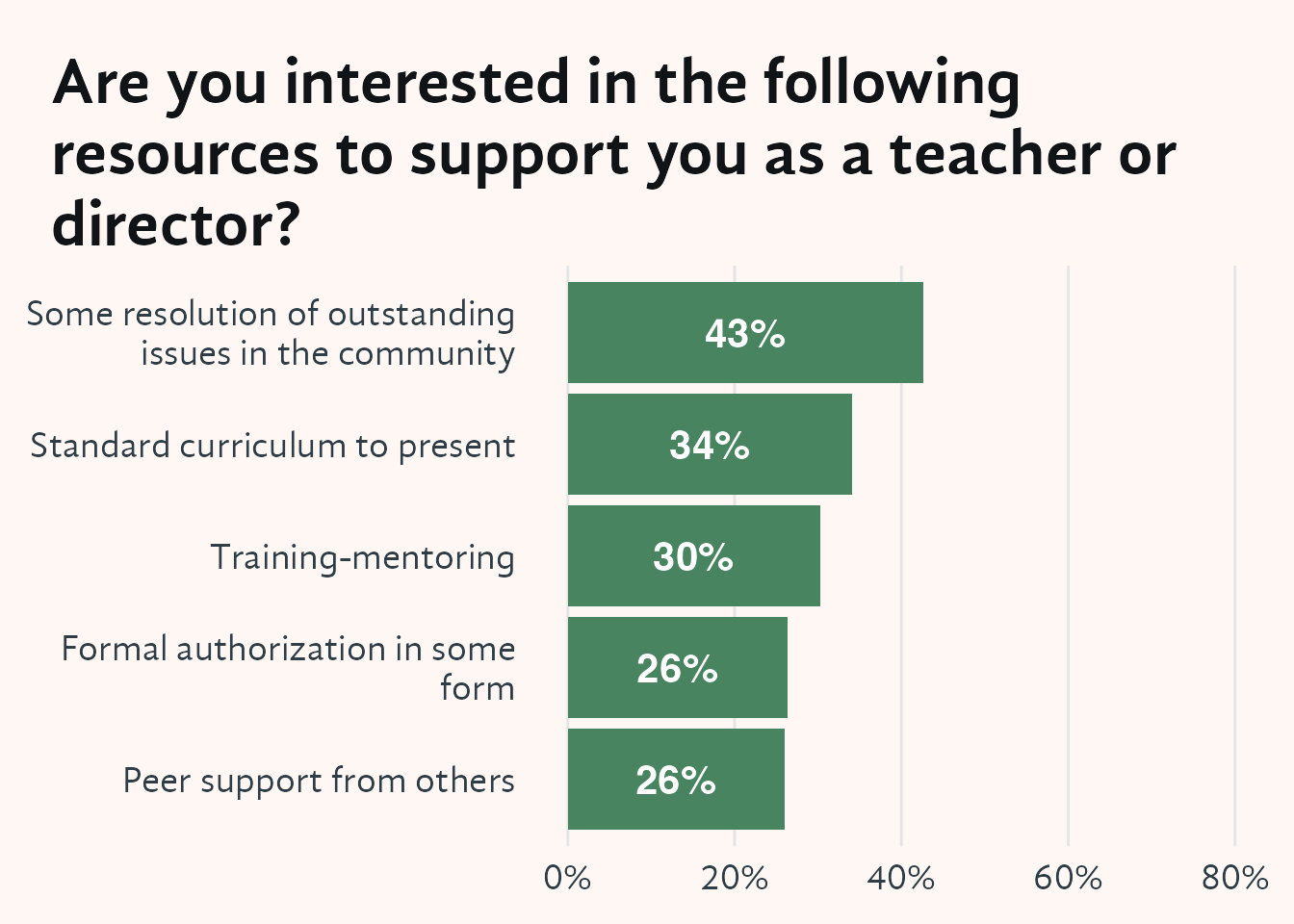
More than a quarter would like access to mentoring or peer support. Higher priorities for these teachers include addressing issues in the community, and having a standard curriculum available to present.
| Are you interested in the following resources to support you as a teacher or director? | |||
| Possible resource | Yes, I would like more of this | I already have access to this | I am not interested in this |
|---|---|---|---|
| Some resolution of outstanding issues in the community | 43% | 20% | 28% |
| Standard curriculum to present | 34% | 40% | 17% |
| Training-mentoring | 30% | 41% | 21% |
| Formal authorization in some form | 26% | 39% | 25% |
| Peer support from others | 26% | 50% | 16% |
Only 37 of the 258 individuals who responded that they were teachers or Shambhala Training directors provided additional comments. Some respondents clarified that they would like to continue teaching, but have personal circumstances that make that difficult. Others are having difficulty identifying a teaching role or their status as a teacher.
Examples
Other respondents elaborated on issues related to conflict in the community that impact their teaching roles.
Examples
A few requested specific types of support or training, for example:
Examples
3 Meditation Instructors
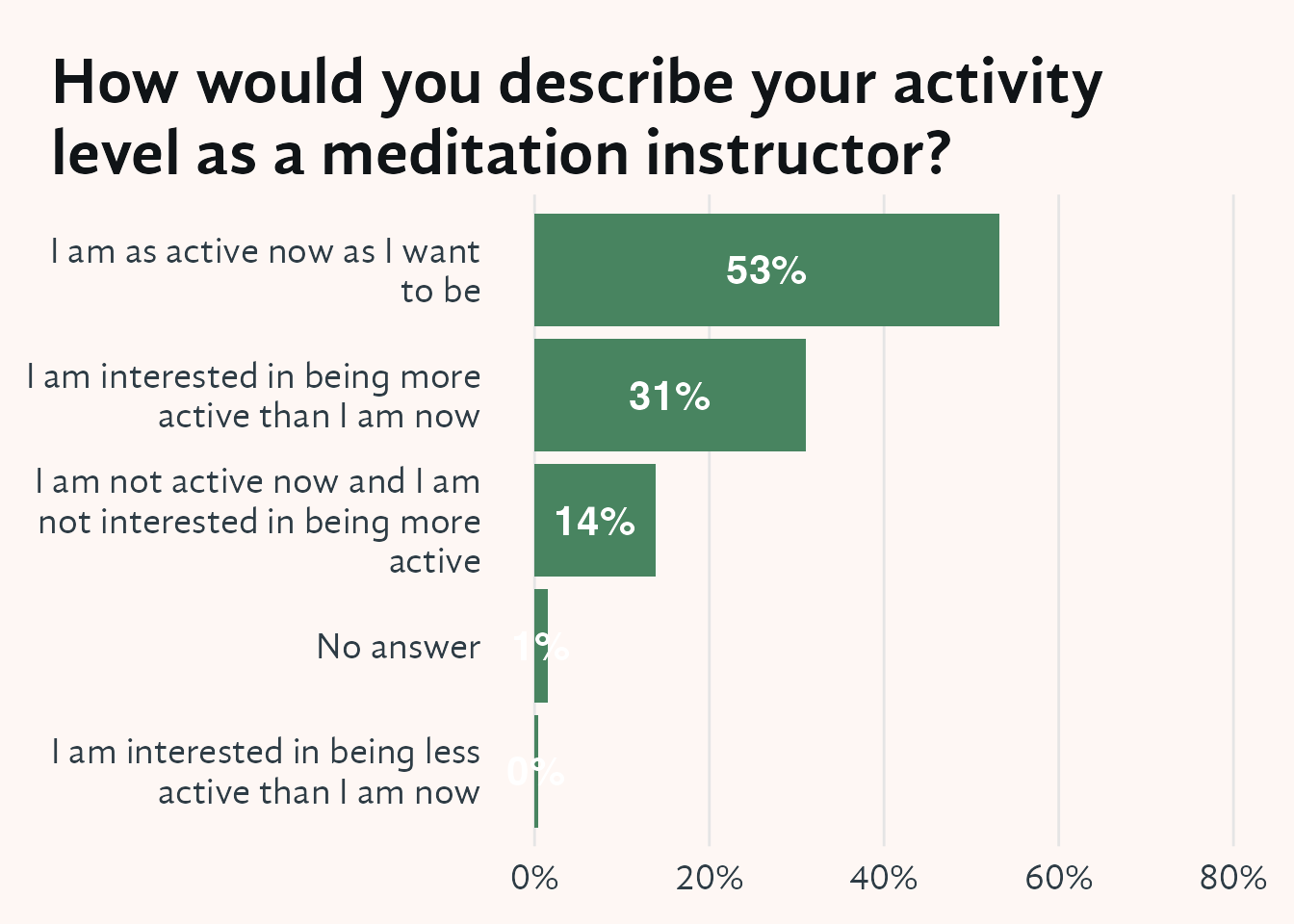
Most meditation instructors responding are active in this role, with a sizeable proportion being interested in being more active.

More than 40% of meditation instructors indicated that they already had access to these sources of support. About one quarter would like more mentoring or training, and slightly more than a quarter would like more peer support.
| Are you interested in the following resources to support you as a Meditation Instructor? | |||
| Possible resource | Yes, I would like more of this | I already have access to this | I am not interested in this |
|---|---|---|---|
| Peer support from other meditation instructors | 26% | 44% | 24% |
| Training-mentoring | 23% | 43% | 27% |
| Formal authorization in some form | 15% | 44% | 31% |
Only 28 of the 469 individuals who responded that they were meditation instructors offered additional comments. Some requested clarification of their status:
Examples…
There were also suggestions for more training in particular areas: how to end relationships with meditation students, working with people with ADD and trauma, offering guided meditation and empowerments for particular practices.
4 Interest in different kinds of support
Respondents indicated interest in many different kinds of support. Only “Yes, I’m interested” responses are shown here.
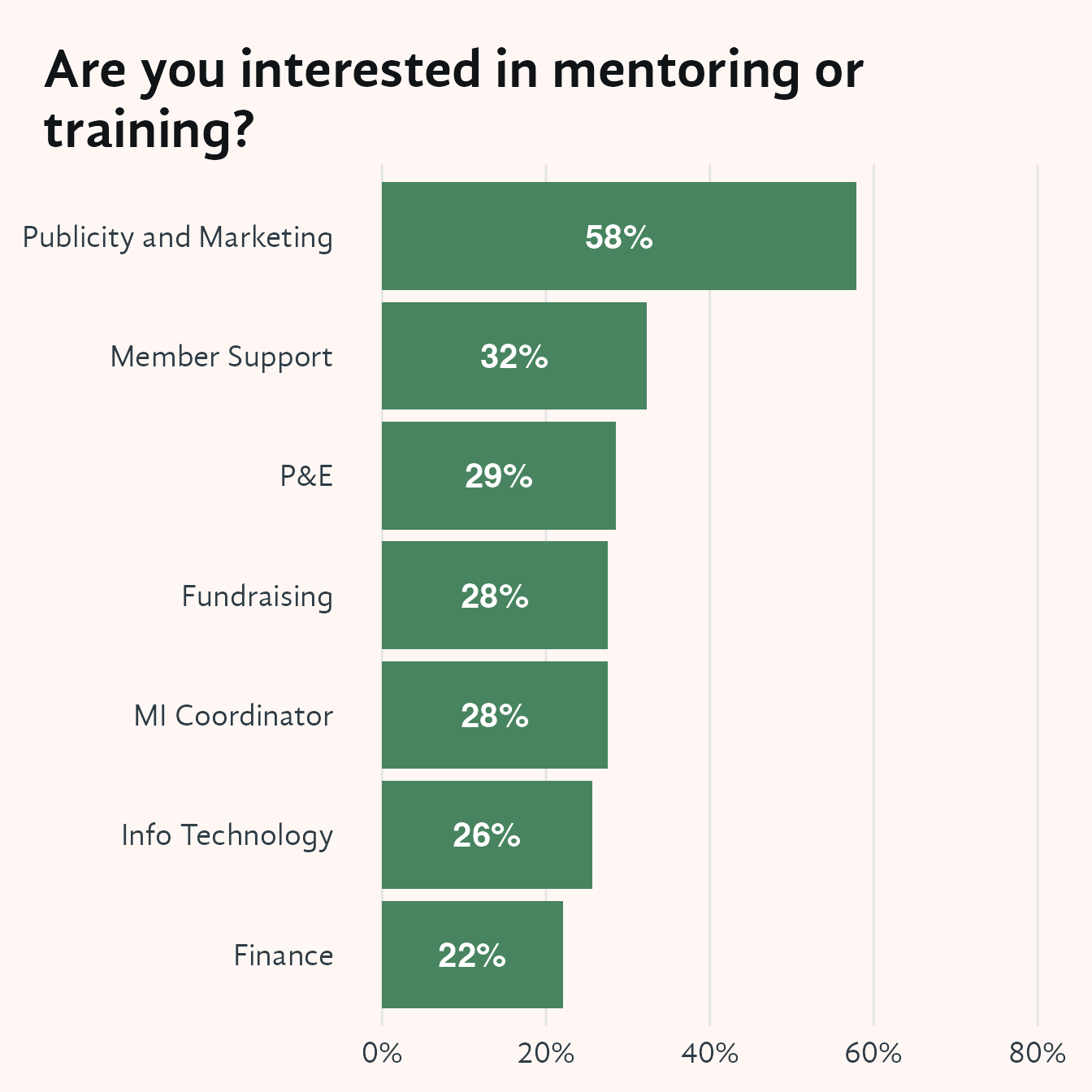
Interest in mentoring or training about publicity and marketing is about twice the level of interest in other areas. The ordering shows which positions have the greatest unmet demand for this kind of support.
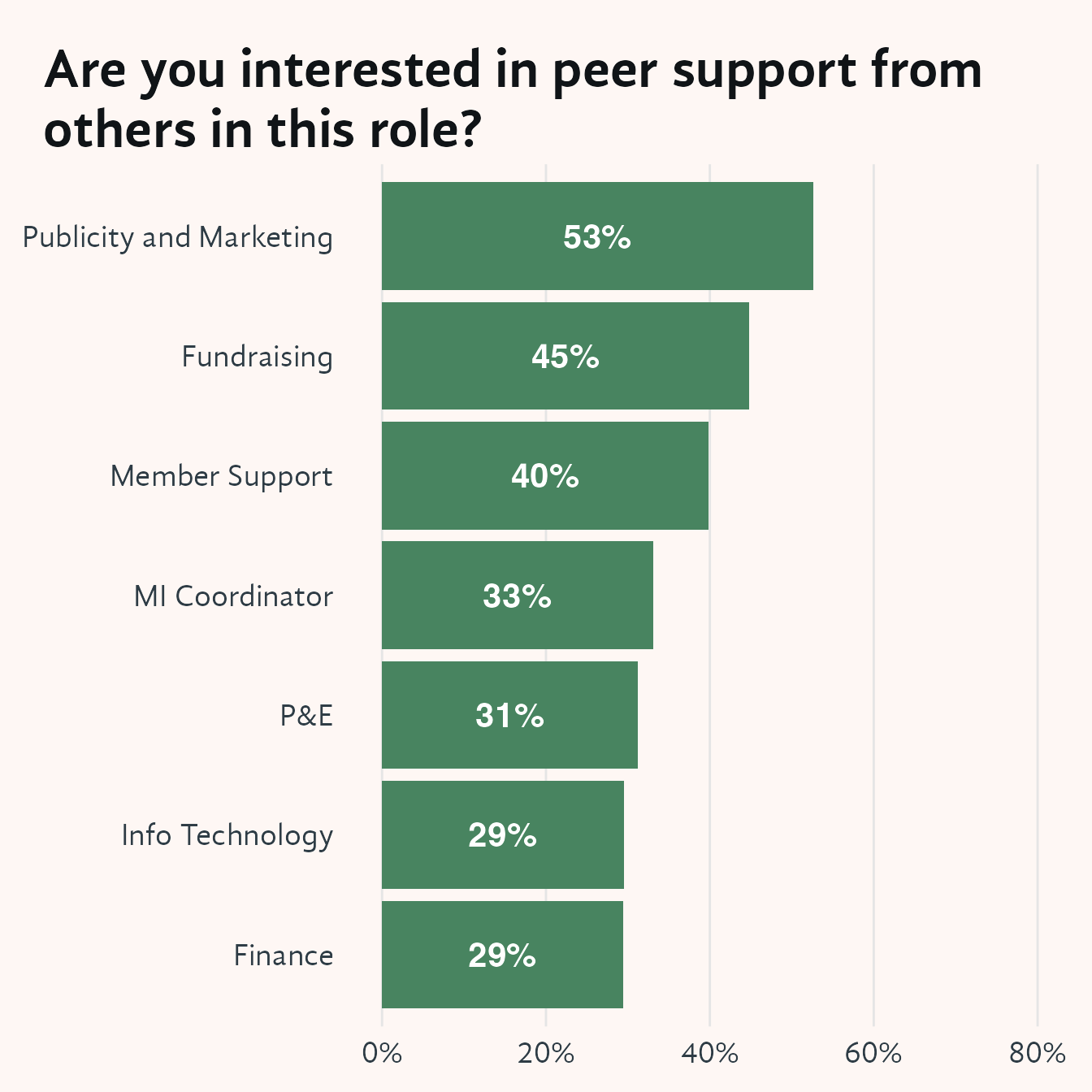
There is great interest in peer support, most about publicity and marketing and least about finance.
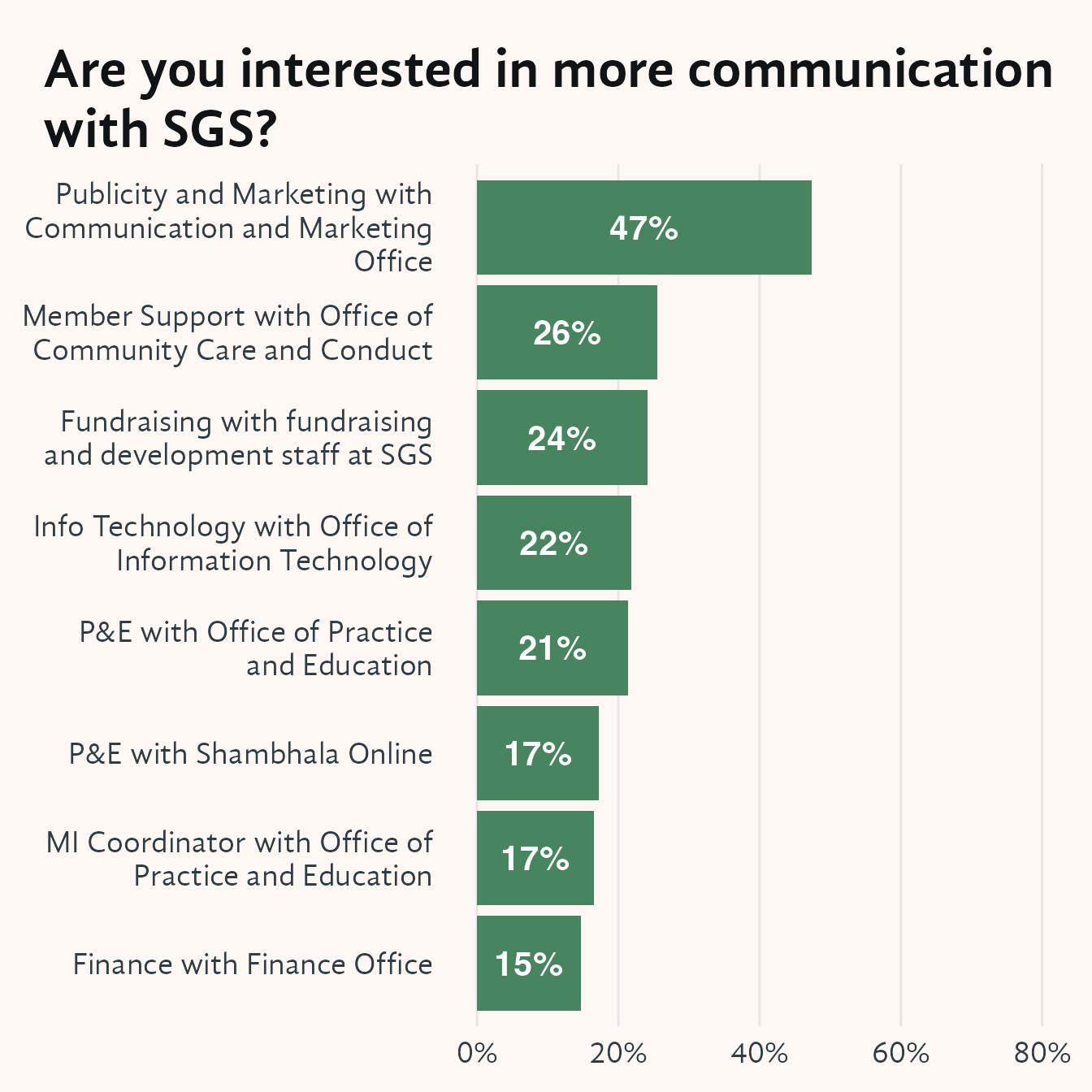
The interest in more communication with SGS in the publicity and marketing area was much greater than in any other areas.

5 Someone able to step in
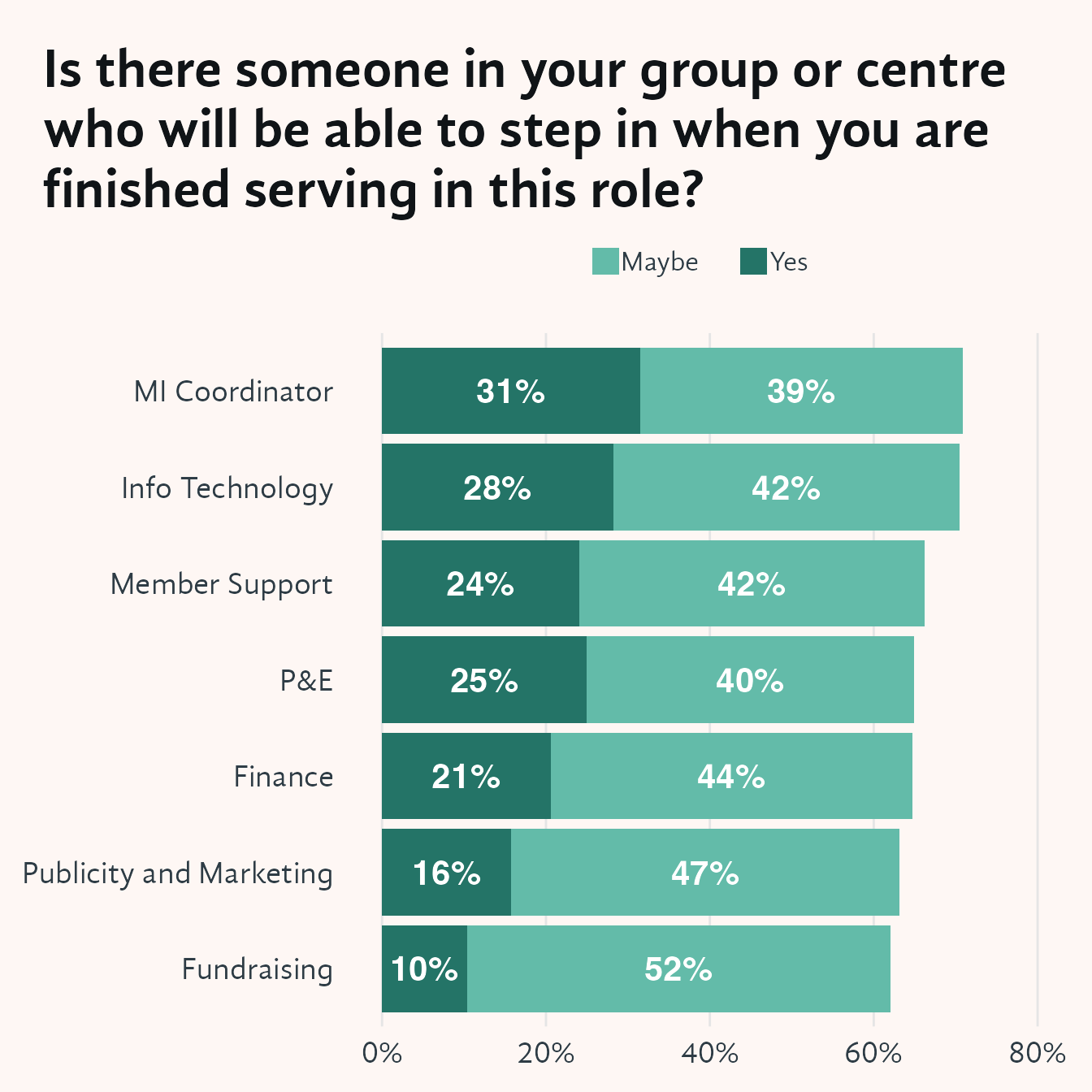
Across all seven service roles, fewer than a third of current role-holders report that someone at their group or centre could step in when they are done — indicating a widespread gap in identified successors, most pronounced in fundraising, publicity and marketing and finance.
6 Overall support preferences detail
All of the responses to questions about support preferences are summarized in one table.
Click to show all responses in a table
| Kinds of support | Yes, I would like more of this | I already have access to this | I am not interested in this |
|---|---|---|---|
| Teacher / Shambhala Training Director | |||
| Training-mentoring | 30% | 41% | 21% |
| Peer support from others | 26% | 50% | 16% |
| Standard curriculum to present | 34% | 40% | 17% |
| Formal authorization in some form | 26% | 39% | 25% |
| Some resolution of outstanding issues in the community | 43% | 20% | 28% |
| Meditation Instructor | |||
| Training-mentoring | 23% | 43% | 27% |
| Peer support from other meditation instructors | 26% | 44% | 24% |
| Formal authorization in some form | 15% | 44% | 31% |
| P&E | |||
| Training-mentoring | 29% | 39% | 27% |
| Peer support from people who serve in this role at other centres | 31% | 38% | 24% |
| Curriculum and programming suggestions | 39% | 35% | 21% |
| Communication with the Office of Practice and Education in SGS | 21% | 42% | 30% |
| Communication with Shambhala Online | 17% | 39% | 35% |
| MI Coordinator | |||
| Training-mentoring | 28% | 46% | 20% |
| Peer support from people who serve in this role at other centres | 33% | 42% | 20% |
| Ideas for the training and support of meditation instructors | 39% | 38% | 18% |
| Communication with the Office of Practice and Education in SGS | 17% | 46% | 24% |
| Finance | |||
| Training-mentoring | 22% | 24% | 46% |
| Peer support from people who serve in this role at other centres | 29% | 21% | 44% |
| Step by step guidance for financial reporting | 22% | 32% | 41% |
| Communication with the Finance Office of SGS | 15% | 40% | 37% |
| Fundraising | |||
| Training-mentoring | 28% | 24% | 31% |
| Peer support from people who serve in this role at other centres | 45% | 21% | 28% |
| Communication with fundraising and development staff at SGS | 24% | 31% | 38% |
| Publicity and Marketing | |||
| Training-mentoring | 58% | 11% | 16% |
| Resources to make better use of social media and other communication technologies | 74% | 5% | 11% |
| Peer support from people who serve in this role at other centres | 53% | 16% | 21% |
| Communication with Communication and Marketing Office of SGS | 47% | 11% | 32% |
| Info Technology | |||
| Training-mentoring | 26% | 53% | 18% |
| Peer support from people who serve in this role at other centres | 29% | 38% | 26% |
| Resources to help make better use of online technology | 46% | 37% | 13% |
| Communication with the Office of Information Technology in SGS | 22% | 55% | 19% |
| Member Support | |||
| Training-mentoring | 32% | 36% | 20% |
| More resources to support members with mental health and other challenges | 46% | 27% | 17% |
| Peer support from people who serve in this role at other centres | 40% | 26% | 23% |
| Communication with the Office of Community Care and Conduct in SGS | 26% | 39% | 25% |