| Which frameworks for spiritual guidance | |||
| N: All repondents | |||
| Yes | Not sure | No | |
|---|---|---|---|
| In general, does spirituality serve as a guide or framework for making choices in your life? | 94% | 5% | 1% |
| Do you think of the Buddhist tradition as providing you with spriritual guidance or a framework for making choices in your life? | 95% | 3% | 1% |
| Do you think of the Shambhala teachngs as providing you with spiritual guidance or a framework for making choices in your life? | 86% | 10% | 4% |
What Do They Value and Need

1 Role of different spiritual frameworks
Nearly all the respondents reported that spirituality serves as a guide or framework for decisions in their lives, and that the Buddhist tradition in general provided this. A substantial majority reported that the Shambhala teachings, specifically, provided such guidance.
2 Rating the usefulness spiritual guidance sources (sangha members, MIs, teachers, books)

| Usefulness of guidance sources | ||||
| Source | Useful | Somewhat useful | Not useful or don't know | N |
|---|---|---|---|---|
| A sangha or community member whom I respect | 82% | 15% | 4% | 1,154 |
| Books by Chögyam Trungpa | 77% | 18% | 5% | 1,152 |
| Other books about Buddhism | 77% | 20% | 3% | 1,131 |
| One or more teachers connected to Chogyam Trungpa, Rinpoche | 71% | 19% | 9% | 1,150 |
| One or more teachers not connected to Chögyam Trungpa, Rinpoche | 68% | 22% | 10% | 1,117 |
| A meditation instructor in the Shambhala community | 55% | 25% | 20% | 1,121 |
For this question, respondents could check as many boxes as they wished. The largest number of respondents overall said that a sangha member whom they respect was useful to them; over three quarters find books almost as useful as guidance sources, whether or not by Chögyam Trungpa Rinpoche. Many respondents found teachers helpful, though only just over half of respondents overall found an MI to be helpful as a guidance resource.
3 Spiritual guidance and support sources
4 Sources of spiritual guidance and support - by generation

| Sources of useful spiritual guidance and support | ||||
| By year started in Shambhala | ||||
| Source | 70's-80's | 90's-2007 | 2008-2017 | 2018-2025 |
|---|---|---|---|---|
| A sangha or community member whom I respect | 81% | 80% | 84% | 83% |
| Other books about Buddhism | 74% | 78% | 80% | 77% |
| A meditation instructor in the Shambhala community | 42% | 56% | 62% | 68% |
| One or more teachers not connected to Chögyam Trungpa, Rinpoche | 73% | 69% | 66% | 60% |
| One or more teachers connected to Chogyam Trungpa, Rinpoche | 80% | 72% | 69% | 59% |
| Books by Chögyam Trungpa | 86% | 79% | 76% | 59% |
| Denominator is number of responses to each item. Rows are arranged from the greatest to the least difference across generations. | ||||
Respected sangha members are the most valued source of guidance across all generation cohorts. Newer members lean more toward meditation instructors and place less weight on books by Chögyam Trungpa or other formal teachers than those who entered Shambhala in earlier decades.
5 Spiritual guidance or framework - by Generation
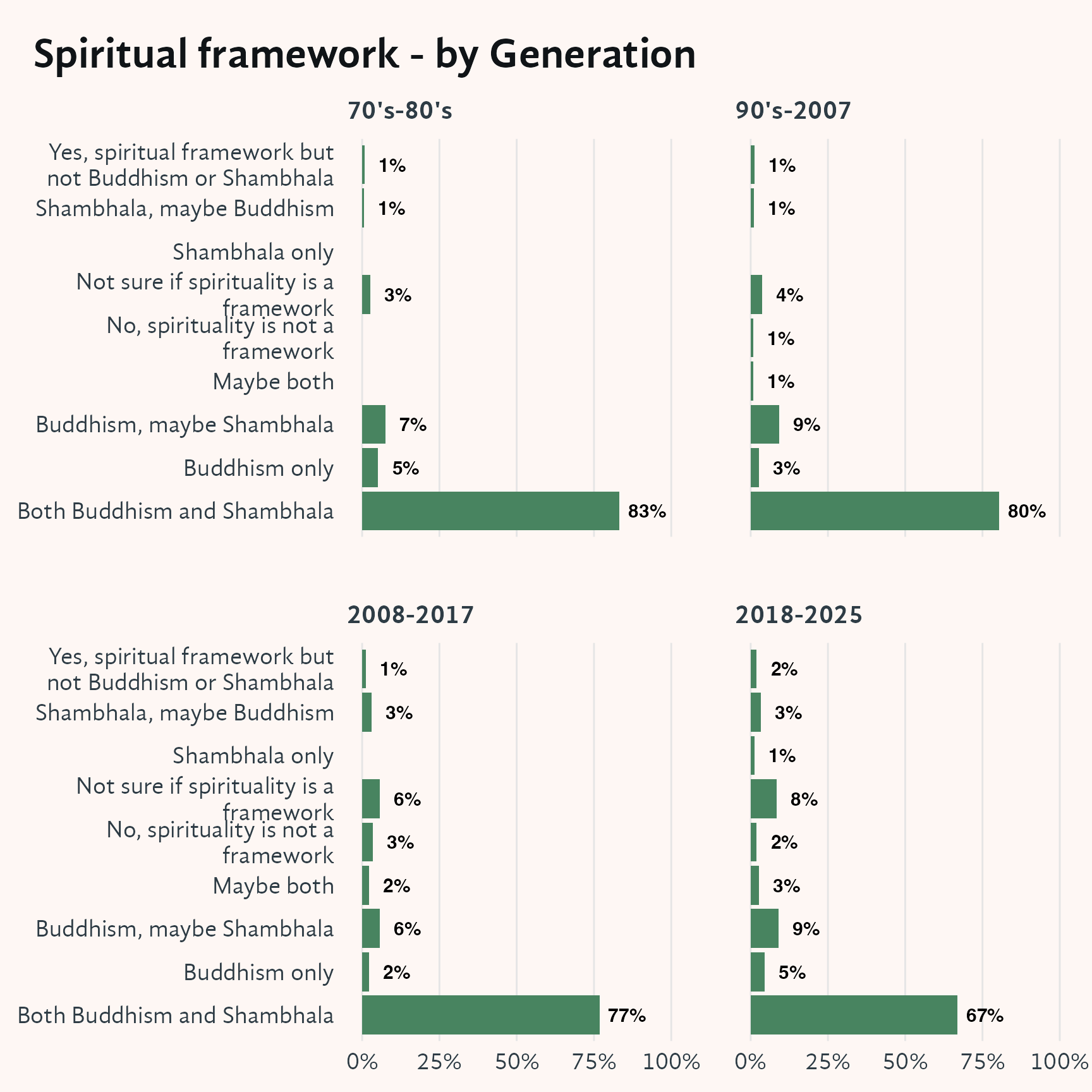
| Which of the following best describes your spiritual framework, if any? | ||||
| By year started in Shambhala | ||||
| Answers | 70's-80's | 90's-2007 | 2008-2017 | 2018-2025 |
|---|---|---|---|---|
| Both Buddhism and Shambhala | 83% | 80% | 77% | 67% |
| Buddhism, maybe Shambhala | 7% | 9% | 6% | 9% |
| Not sure if spirituality is a framework | 3% | 4% | 6% | 8% |
| Buddhism only | 5% | 3% | 2% | 5% |
| Shambhala, maybe Buddhism | 1% | 1% | 3% | 3% |
| Maybe both | 0% | 1% | 2% | 3% |
| Yes, spiritual framework but not Buddhism or Shambhala | 1% | 1% | 1% | 2% |
| No, spirituality is not a framework | 0% | 1% | 3% | 2% |
| Shambhala only | 0% | 0% | 0% | 1% |
| Denominator is number of responses to each item. Rows are arranged from the greatest to the least percentage of respondents who entered Shambhala between 2018 and 2025. | ||||
While this question attracted quite a wide variety of responses, generally a majority, or a large majority, stated that both Buddhism and Shambhala provided their spiritual framework. The longer the time respondents had been with Shambhala, the more positively they responded here. However, there was some concern about the notion that spirituality is a ‘framework’, which may have affected the total numbers answering the question more affirmatively, with more recent generations having more of an issue with this.
6 Availability of practice/study resources (paths, teachers, courses, meditation guidance)
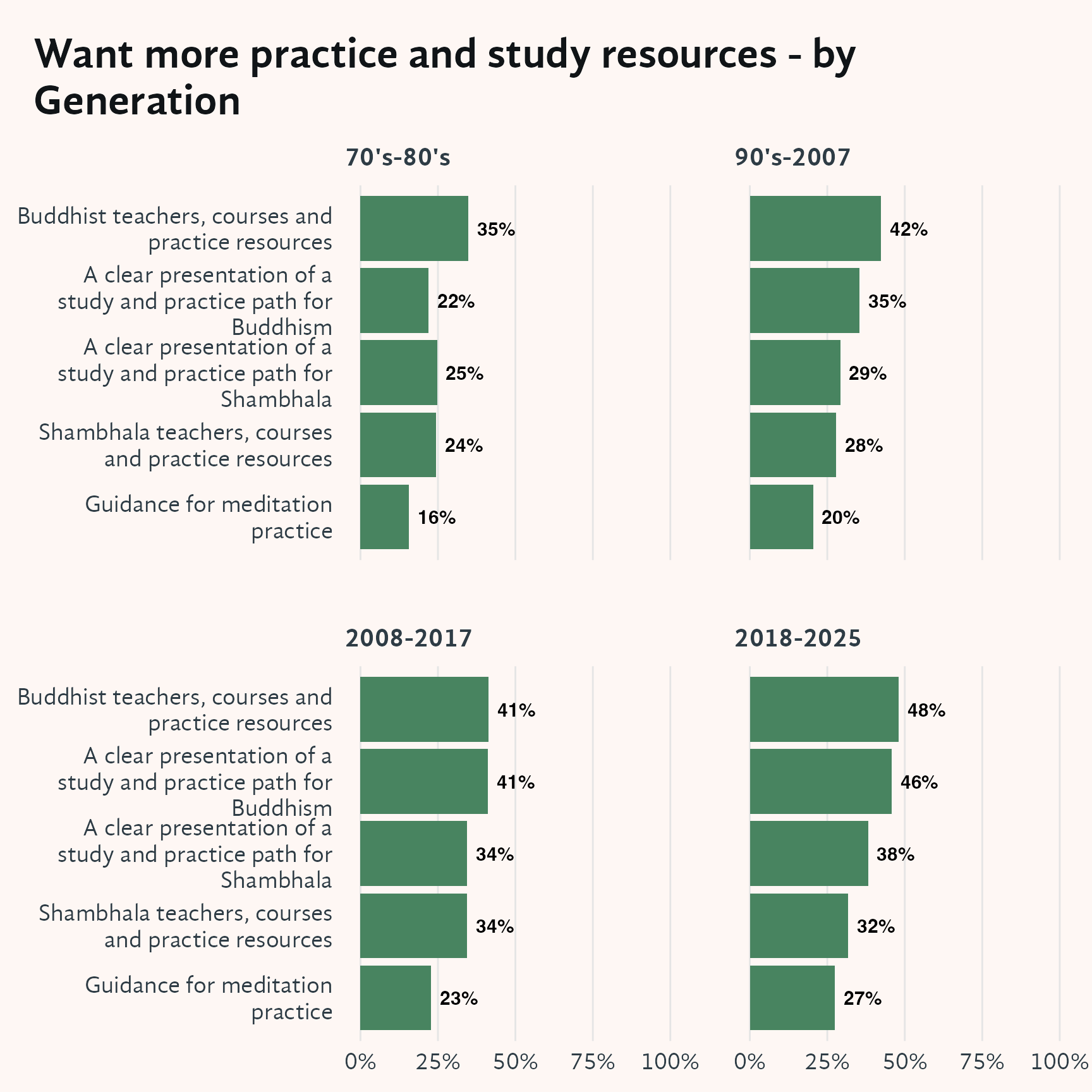
| Want more practice and study resources | ||||
| Percentage of respondents who would like more of this resource, by year started in Shambhala | ||||
| Community Resource | 70's-80's | 90's-2007 | 2008-2017 | 2018-2025 |
|---|---|---|---|---|
| Buddhist teachers, courses and practice resources | 35% | 42% | 41% | 48% |
| A clear presentation of a study and practice path for Buddhism | 22% | 35% | 41% | 46% |
| A clear presentation of a study and practice path for Shambhala | 25% | 29% | 34% | 38% |
| Shambhala teachers, courses and practice resources | 24% | 28% | 34% | 32% |
| Guidance for meditation practice | 16% | 20% | 23% | 27% |
| Denominator is number of responses to each item. Rows are arranged from the greatest to the least percentage of respondents who entered Shambhala between 2018 and 2025. | ||||
Survey respondents broadly want more access to Buddhist teachers, courses, and practice resources. The most pronounced generational difference is around having a clear presentation of the study and practice path — newer members express considerably more interest in this for both Buddhism and the Shambhala teachings than those who entered in earlier decades.
7 Availability of community resources (peer support, leadership/teacher/MI training)
| Availability of community resources | |||
| Resource | I have what I need | I would like more of this | I am not interested at this time |
|---|---|---|---|
| A supportive group of fellow practitioners | 63% | 27% | 10% |
| Leadership training | 34% | 21% | 45% |
| Teacher training | 31% | 23% | 45% |
| Meditation instructor training | 41% | 20% | 38% |
8 Availability of community resources (peer support, leadership/teacher/MI training) by Generation
| Availability of community resources | ||||
| Percentage of respondents who would like more of this resource, by year started in Shambhala | ||||
| Community resource | 70's-80's | 90's-2007 | 2008-2017 | 2018-2025 |
|---|---|---|---|---|
| A supportive group of fellow practitioners | 24% | 30% | 28% | 28% |
| Meditation instructor training | 13% | 21% | 25% | 24% |
| Leadership training | 13% | 23% | 27% | 21% |
| Teacher training | 15% | 28% | 30% | 19% |
| Denominator is number of responses to each item. Rows are arranged from the greatest to the least percentage of respondents who entered Shambhala between 2018 and 2025. | ||||
Overall, and particularly among the most recent generation, the largest number of respondents reported that they would like more access to Buddhist teachers, courses and practice resources. Generations differed most in their interest in having a clear presentation of the study and practice path, particularly for Buddhism, but also for the Shambhala teachings. Those newer to Shambhala had more interest in this than those who entered in earlier decades. Overall, the responses show that many participants would like better access to such resources.
9 Opportunities that would enhance experience (social issues, body practice, arts, diversity, cost, childcare, etc.)
| Opportunities that would enhance my experience | ||||
| Percentage of respondents who would like more of this resource, by year started in Shambhala | ||||
| Oportunity | 70's-80's | 90's-2007 | 2008-2017 | 2018-2025 |
|---|---|---|---|---|
| More movement and body practice opportunities | 21% | 23% | 28% | 36% |
| More exploration of how meditation relates to social issues | 26% | 29% | 30% | 32% |
| More study and practice options with other Tibetan teachers | 38% | 36% | 40% | 31% |
| Study and practice opportunities that are less expensive | 24% | 23% | 27% | 27% |
| More arts and creativity related activities | 23% | 23% | 27% | 27% |
| More convenient or more frequent in-person activities | 16% | 17% | 28% | 26% |
| More opportunities for interacting with the wider local community | 20% | 19% | 27% | 25% |
| More in-person social activities | 17% | 15% | 16% | 20% |
| Other (please specify) | 20% | 22% | 16% | 14% |
| More activities focused on people between the ages of 18 and 34 | 9% | 6% | 9% | 9% |
| More child care availability during programs and meditation sessions | 4% | 3% | 5% | 5% |
| Denominator is number of responses to each item. Rows are arranged from the greatest to the least percentage of respondents who entered Shambhala between 2018 and 2025. | ||||
Among the 228 open text responses, the most frequent theme mentioned was Vajrayana study and how to access this, either for existing or for aspiring students. The second most frequent concerned more online offerings, particularly hybrid ones. There were calls for more practice or activity around societal action, environmental issues or generally benefiting others. There were also requests for teachers who themselves had studied with Trungpa Rinpoche, and for visiting teachers and Rinpoches. An equal number were wanting to study with the Sakyong, to have greater recognition for him in Shambhala or have a lineage teacher replace him.
Examples…
In order of frequency, other major categories of responses included more access to knowledgeable teachers.
Examples…
More online offerings:
Examples…
More sense of inclusion and accessibility:
Examples…
A clearer relationship to a lineage teacher, including Sakyong Mipham:
Examples…
Enhanced local community experiences and support for groups and centres:
Examples…
And more attention to the application of teachings to daily life:
Examples…
10 Changes that would enhance experience (vision clarity, conflicts, past problems, diversity, safety)
| Changes that would enhance my experience | ||||
| Percentage of respondents who would like more of this resource, by year started in Shambhala | ||||
| Change | 70's-80's | 90's-2007 | 2008-2017 | 2018-2025 |
|---|---|---|---|---|
| More clarity about the current community vision | 44% | 44% | 45% | 37% |
| More diversity in the community | 25% | 28% | 31% | 29% |
| More sense of connection with others | 24% | 28% | 29% | 26% |
| More acknowledgement of past problems | 20% | 22% | 22% | 19% |
| Teachers who are more knowledgeable | 14% | 13% | 10% | 16% |
| Fewer internal conflicts | 27% | 21% | 21% | 14% |
| Less feeling at risk for harm | 4% | 7% | 6% | 3% |
| Denominator is number of responses to each item. Rows are arranged from the greatest to the least percentage of respondents who entered Shambhala between 2018 and 2025. | ||||
The largest portion of respondents cited more clarity about the current community vision as the change that would enhance their experience in Shambhala. However, there was a notable difference across generations: more respondents who entered Shambhala between 2008 and 2017, arguably the rising generation of leaders in the community, selected this as a desired change.
Around 39% of this cohort also felt that more diversity in the community and more sense of connection with others would be desirable. Acknowledgement of past problems and fewer internal conflicts were still an issue for some, though for slightly fewer of the most recent entrants.
197 respondents offered additional open text answers to this question. The largest category of answers related to Sakyong Mipham and fall out from the split in the community.
Examples…
The next three largest categories had an equal number of responses and concerned leadership quality, teacher quality and desire for engaged Buddhism.